

You ever have one of those housing policy conversations where you ask the other person to repeat what they just said like three times just to make sure you understood correctly because what they’re telling you is so fucking cool?
No? Just me?
Well, perhaps I can help you all enjoy the experience second hand.
I recently had a conversation with some of the fine folks from the Alameda County Department of Housing and Community Development (Alameda HCD) and over the course of a wide-ranging conversation, they told me all about the new program they’re piloting: the Scalable Housing Infill Funding Toolkit, or SHIFT.
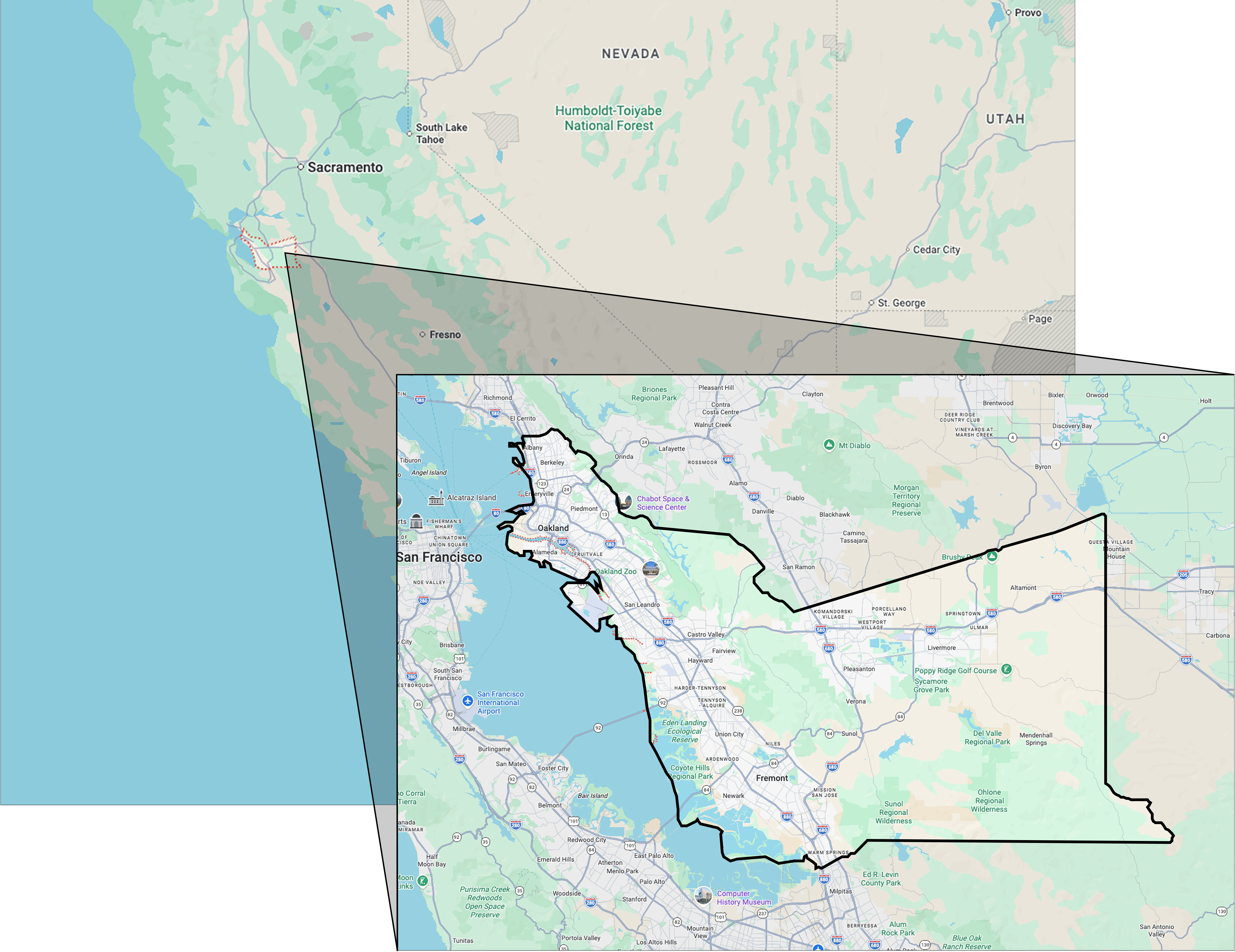
The SHIFT program is designed to solve, or at least test solutions for, three problems:
Enabling seniors to age in place
Scaling funding for subsidized housing
Jumpstarting private investment in missing middle housing
Yes, they want to make progress on all of those aims with a single program. If those sound like only loosely-related policy goals, fear not, dear reader, it’ll all make sense by the end.
How SHIFT helps Seniors Age in Place
The American housing market is not a great place for getting old. Large-lot, two-story single-family homes in sprawling suburbs are the norm. And as we get older, having to drive everywhere becomes untenable. At a certain point, even going up and down the stairs gets hard.1
The problem for older Americans is that we’ve largely outlawed any alternatives.
In most communities, there is no small-lot single-story townhome to move into. That leaves older Americans with a stark choice: stick it out in a house that’s too big and increasingly difficult to live in, or move to a retirement community in Florida.
SHIFT aims to offer a third option. The SHIFT program will enable seniors to age in place by simply building the housing that they need in the place they actually need it. It will do that by providing a two-bedroom ADU on the senior’s lot.
This is only possible because of a California state-level law called SB9 which allows larger lots to be split and extra housing added on the new parcels. Administratively, this is a challenging process; in my reckoning several steps above dealing with the DMV, in terms of the complexity and red tape. To eliminate the compliance burden on seniors who just need new housing, the program administrators will take on the burden of SB9 paperwork and abstract away that complexity.
At this point, the discerning reader might say that sounds cool, but who’s paying for this?
Great question, I’m glad you asked. This is the fun part.
Construction is funded by a loan from the program’s financial partner the San Francisco Housing Accelerator Fund (HAF).2 Once the senior moves into their new ADU, they sell their old house and the proceeds will be used to pay back the construction loan. There’s also a separate loan from the county itself that covers soft costs and program administration; this smaller county loan sits subordinate to the HAF loan and if there’s not enough leftover from selling the original home, the remaining balance converts to something like an equity stake in the senior’s new ADU.3
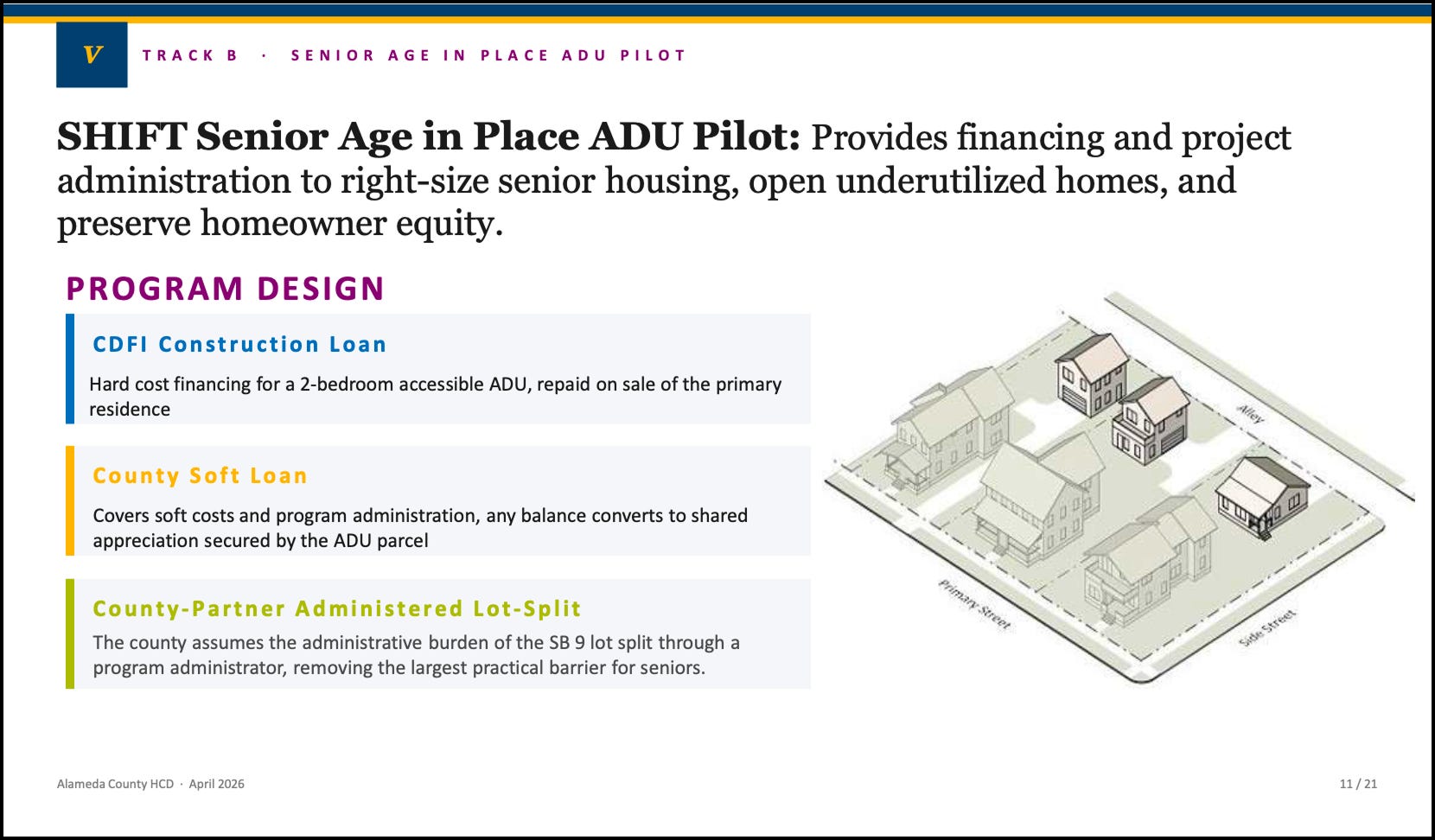
Notice what’s going on here. This isn’t a subsidy program in the traditional sense. All the capital gets paid back in full, so this program should be able to operate in perpetuity. That means the question of funding isn’t a question of whether or not to keep it going; it’s really just a matter of how aggressively policy-makers are willing to scale.4
That was SHIFT’s senior housing track, but the program is taking on workforce housing as well.
How SHIFT builds workforce housing
Subsidized housing is hard to build in the U.S. Part of the problem is that our standard funding mechanisms range from actively bad (un-funded inclusionary zoning) to overly complex (LIHTC). The net result is we don’t build nearly as much subsidized housing as we could, even in those few places where it’s theoretically legal.
SHIFT will test new ways of financing infill development intended for working-class renters with the goal of housing more people at lower costs than standard methods currently allow.
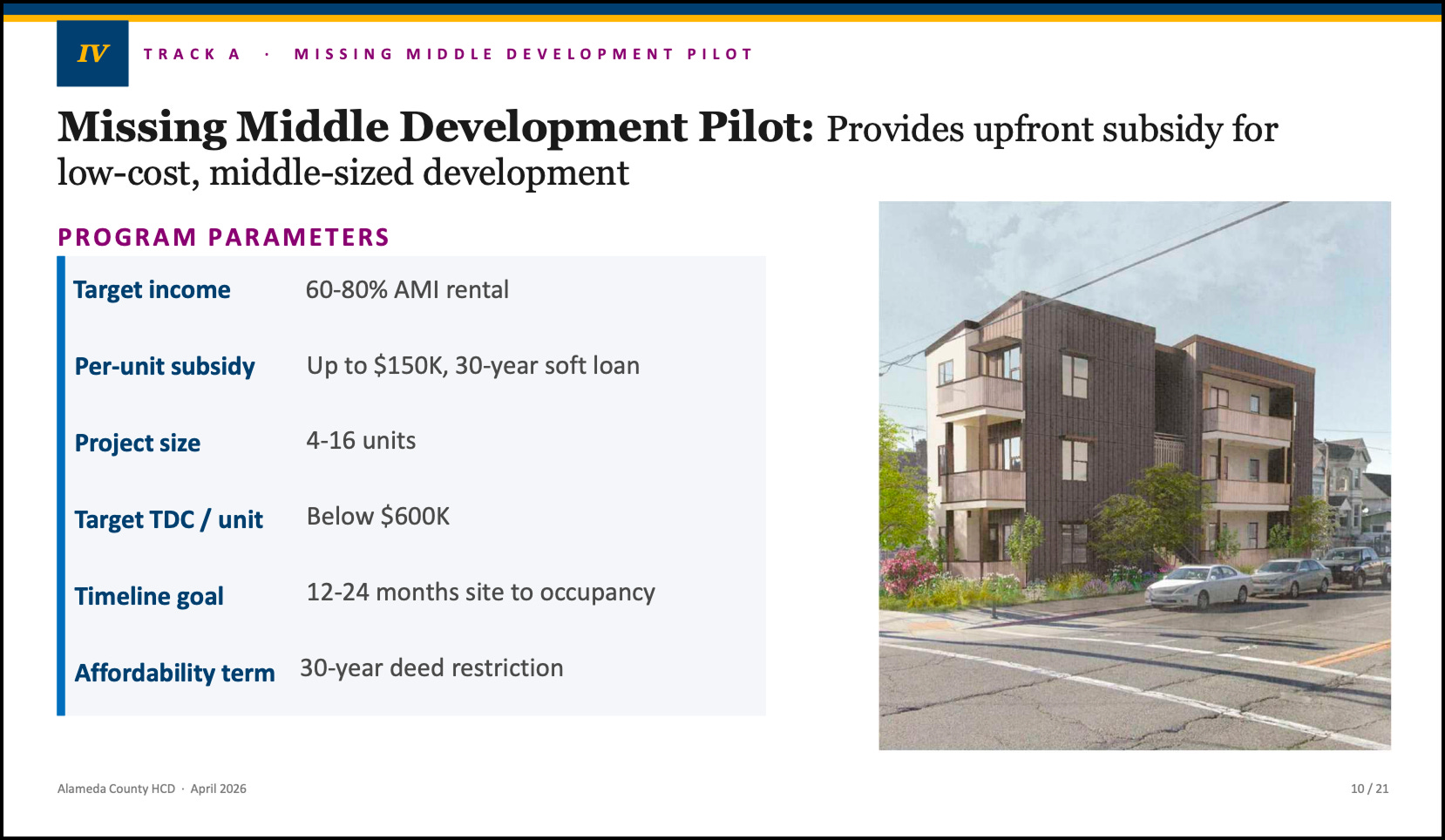
So how is SHIFT going to get more below-market-rate (BMR) housing built in a subsidy-efficient way? They hope to do it with five different techniques.
Lower land-acquisition costs: Parcels will come from a range of sources including tax-defaulted county land as well as institutional sites like churches which have their own development rights under California’s YIGBY reforms.5
Elimination of predevelopment and financing assembly timelines: projects can spend three to seven years in financing assembly before even starting on construction. Carrying costs accumulate the whole time. SHIFT will eliminate that by being a one-stop source of financing.
Smaller project size: smaller projects (e.g. 6 to 12 units) take less time to build. Getting something done in 1 to 2 years as opposed to 5 to 8 (for much larger, traditional BMR projects) reduces carrying costs that result in lower per-unit production costs.
Pre-approved designs: working off standardized designs eliminates $50,000–$100,000 in architectural fees and permitting uncertainty per project. Once a plan set is approved in one city, it can be submitted to the next at minimal additional cost.
Modular and prefabricated construction: factory-built components reduce on-site labor costs and construction timelines. The aggregated pipeline gives SHIFT negotiating leverage with suppliers that no individual small developer has.
Leveraging these strategies, Alameda County HCD believes it can build BMR units for 25% less than typical subsidized housing in the region.6 And while this part of the program is a public subsidy in the traditional sense (i.e. this is public money out the door) the longer-term plan is to use these early projects as a means for jumpstarting the infill development market.
How SHIFT jumpstarts private investment
Financing is a major challenge for missing middle development. Real estate financiers lend money to things they understand and, since missing middle housing types have been mostly illegal for the better part of a hundred years, there aren’t many real estate investors who feel like they understand it.7 This creates a chicken-or-the-egg problem where the money people need historical data to do their risk modeling, but there is no historical data, and there won’t be because no one will build. SHIFT’s role here is to have the public sector go through the learning curve on behalf of everyone else.
And even though these projects will be BMR, they’ll still produce all the basic information private investors need to begin evaluating projects. As SHIFT projects begin generating information about construction costs, market demand, etc., they’ll be doing something like financial cloud seeding, setting up private capital to come raining down from the heavens and watering the next generation of Alameda County infill development.
The Takeaways
SHIFT is piloting solutions for three major problems within housing policy: senior housing, workforce housing, and financing for missing middle development. A public program tackling just those three issues by themselves would be worth the thousand-word post, but there’s even more here to be excited about.
First is that this program is only possible because of an extensive series of reforms. The program prospectus names eleven different laws passed over the last five years that make the kind of housing SHIFT is designed to finance legal to build in the first place. I want to say this again, because it bears repeating: there’s simply an order of operations to reform. Only after we solve the legalization problem are we able to figure out the finance challenge.
It’s also worth noticing that the laws in question were state-level laws. Taken together, they represent more progress than any one city in California has been capable of achieving on its own. And they demonstrate the need for state-level legislation as part of a larger process of reform.8
The other point worth appreciating is the fact that SHIFT is, effectively, a series of experiments. A group of forward-looking folks at the Alameda HCD stood up this program to find better ways to support housing production and make the case for greater investment based on what they figure out actually works. It’s this kind of entrepreneurial initiative we need more of from policy-makers and exactly the approach to public service we should want to see across the country.
***
For folks who want to read more, dropping the full program details here. More to come as the pilot progresses.
To see the truth of how utterly inhospitable the built environment is to the elderly, just think about the fact that we had to invent the concept of a retirement community — a place that’s dense enough not to need a car and full of homes that, if you squint, start to look an awful lot like gentle infill.
HAF is a Community Development Financial Institution (CDFI). CDFIs are a federally designated category of mission-driven lender. Their explicit purpose is to provide capital to underserved markets and communities that conventional banks won’t serve at viable terms.
Technically, the County’s interest is structured as a shared appreciation loan secured by the ADU parcel rather than a direct equity stake. The County remains a lien holder (creditor) rather than a co-owner, meaning its claim on the property is structured as debt with appreciation-linked repayment rather than an ownership share. SHIFT Overview, Alameda County HCD, April 2026, p. 13.
Oh, and for my Prop 13 heads, the sale of the pre-existing house triggers reassessment. So while this doesn’t ameliorate the underlying insanity that is California’s tax code, it’s a short to medium-term fiscal winner for public coffers.
Also worth noting that recent state law has unlocked development potential on thousands of small parcels across the county, but the market hasn't caught up yet.
The comparison is with LIHTC developments where costs currently exceed $700K/unit in the Alameda/East Bay region. SHIFT’s target is to come in below $600K/unit. (SHIFT Overview, p. 10; SHIFT Draft Prospectus)
Missing middle housing is illegal to build on roughly 75% of residential land in the United States.
If you read that sentence as saying, “state law fixes everything,” go back and read the sentence three more times, then read the link, and then put yourself in time out.
I love the SHIFT Senior Age in Place ADU Pilot. It provides practical assistance to seniors while adding desperately needed housing supply. If the pilot is successful, I’d like to see SHIFT sell bonds for the program and wrap the financing costs into the reimbursement formula. That would allow every senior with a qualifying property to benefit while opening up homes for families that currently have few options.