
How Atlanta is trying a new model for below-market-rate housing
New policy, new institutions, and — hopefully — more new housing

Greater Atlanta is the 6th-largest metro area in the United States and a thriving center for the aerospace, healthcare, and entertainment industries. Like many of its peer cities, however, it’s struggled with rising housing costs.1 While there’s an active coalition working to legalize naturally affordable market-rate housing, what I want to highlight today is the city’s approach to below-market-rate development, aka subsidized affordable housing.
Atlanta, like most American cities, has long deployed the standard menu of housing subsidies. These include Inclusionary Zoning, LIHTC-financed projects, and demand-side policies like down payment assistance. These methods have, however, reached their limits. So, in 2023, the city established the Atlanta Urban Development Corporation (AUDC) to go beyond what’s possible with the legacy policy toolkit.
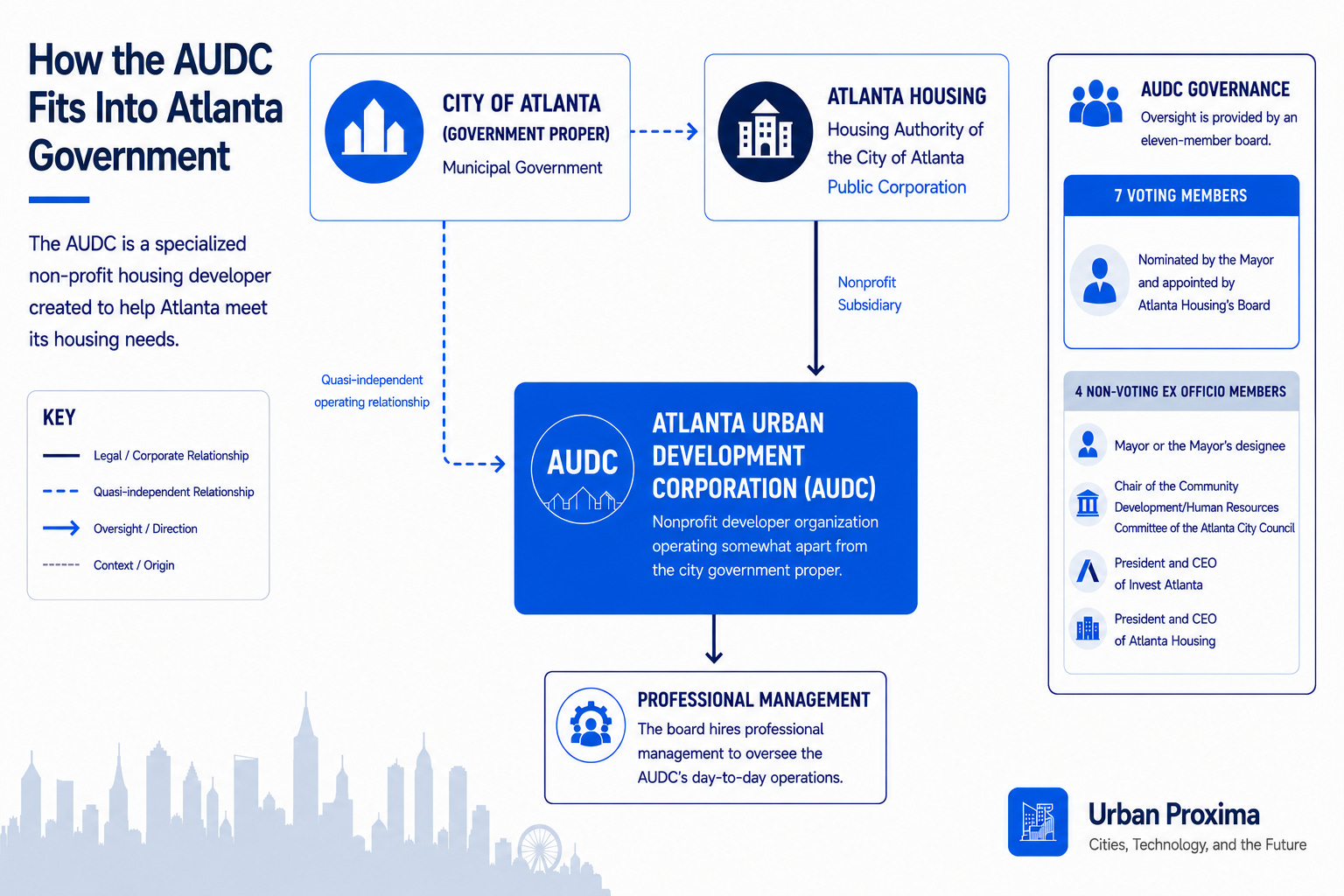
Administratively, the AUDC exists as a quasi-independent entity operating somewhat apart from the city government proper. Officially, it is a nonprofit subsidiary of Atlanta Housing — the Housing Authority of the City of Atlanta — which is itself a public corporation that sits apart from the city government proper.2
Governance of the AUDC is overseen by an 11-member board consisting of seven voting members (nominated by the mayor and appointed by Atlanta Housing’s board) and four non-voting ex officio members. The board is responsible for hiring the professional management team that oversees the organization’s day-to-day operations.
The AUDC was established to advance a broader citywide goal of creating or preserving 20,000 below-market-rate homes by 2030. Where things get interesting is when we go from what it’s supposed to do to how it’s supposed to do it.
The standard American tools for building subsidized affordable housing leave much to be desired. Inclusionary zoning is an inefficient way to generate housing subsidies, and LIHTC’s administrative complexity creates a limited system that can only produce a narrow range of housing. So, the AUDC leverages four strategies to make subsidized housing financially viable.
First, it leverages underutilized public land.3 In a high-cost metro like Atlanta, land acquisition alone can account for up to 20% of a development’s total cost. If the AUDC can show up to a project with public land, they’ll be able to sidestep one of the largest upfront expenses in affordable housing development.4
Second, AUDC projects have access to low-cost public capital. The City of Atlanta’s Housing Production Fund provides loans at 3%-6% interest and can cover up to 20% of a project’s overall capital needs. On top of that, the AUDC also has indirect access to funding from tax-free municipal bonds. The parent org, Atlanta Housing, has the authority to issue tax-exempt public debt and can go to the credit markets on behalf of AUDC projects.
Why is this important? Real estate projects are financed through a mix of debt and equity. The debt has to be repaid at prevailing interest rates, and equity investors typically demand returns around 20% — because otherwise they’d just put their money in index funds. If a project can’t credibly promise those returns, it doesn’t get built. The AUDC uses public capital to replace some expensive private capital with lower-return funding, changing the economics enough to make otherwise infeasible projects viable.
Third, AUDC projects can bundle market-rate housing and retail alongside below-market units (what I like to call reverse inclusionary zoning). The profits from these for-profit components cross-subsidize the affordable ones. The main difference between this and Inclusionary Zoning is that the cost of capital for an AUDC project is lower, so profits earmarked for investor returns can be used as a subsidy.

Fourth, AUDC projects can receive property tax exemptions from Atlanta Housing. The specifics get negotiated on a project-by-project basis, but the point is to reduce the overall tax burden in favor of redirecting that value into housing-specific subsidies.5
So how’s this working out so far?
The good news: based on what I could see in various press releases and official websites, there appear to be at least 16 AUDC projects in various stages of qualification / planning.
The meh news: as far as I can tell, no AUDC projects have yet broken ground. Given the organization was established in July of 2023, we should have gotten at least a few shovels in the ground by now. The main bottleneck seems to be in the developer selection (the AUDC’s model involves them selecting a private development partner to execute on the actual construction). Based on publicly available information, it’s unclear what the hold up is.
When I asked my Atlanta contacts for a vibe-check on the AUDC as a whole, the summarized feedback was good idea, remains to be seen if the execution will be up to snuff.
As it stands, there’s an AUDC project scheduled to break ground this year with a two-year construction timeline. Hopefully this is the point at which the org gains traction and starts delivering on the strategy its been created to enact.
Why does any of this matter?
We should take an interest in Atlanta’s AUDC for a few reasons. For starters, it represents a new approach to subsidized affordable housing in the United States.6 The old ways are insufficient for the task, so I’m excited to see a major U.S. metro figuring out a different path forward on below-market-rate housing policy.
Going beyond policy, though, there may be a lesson here about state capacity. The city, in conjunction with Atlanta Housing, didn’t just give an existing part of the local bureaucracy one more thing to do and expect them to run with it. They stood up a purpose-built organization with specific policy tools and a clear mandate.
We should pay attention to the potential failure mode as well. The main criticism I’ve seen isn’t that the idea is bad, it’s just that the org hasn’t managed to do anything yet. A public organization that doesn’t do anything is far less bad than a public organization that manages to do terrible things. Pruitt-Igoe this is not.
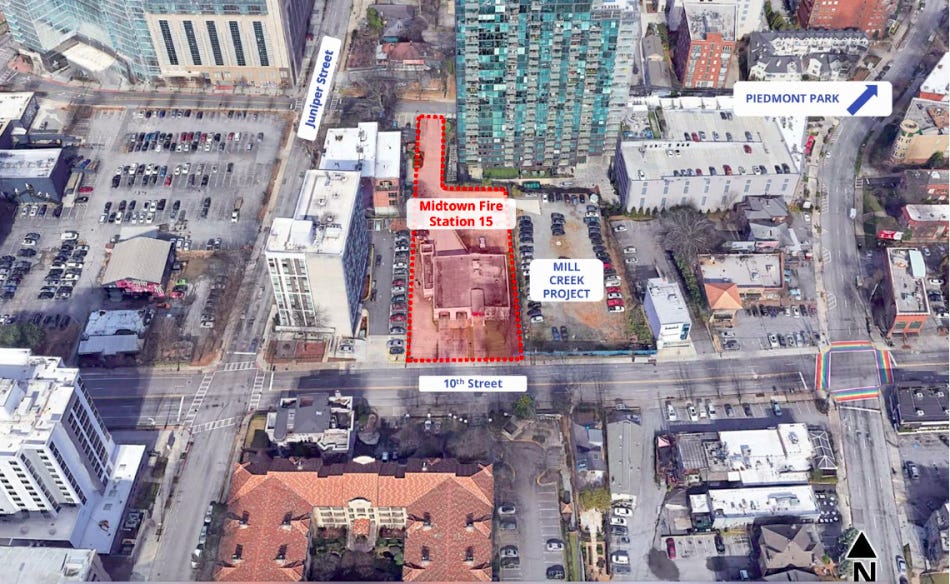
Also note that creating an independent organization provides the kind of flexibility we usually associate with private enterprise. If the organization underperforms, the board can fire the CEO and replace the management (and if they don’t, policymakers can replace the board). If worse comes to worst, the entire AUDC could even be scrapped and fully retired or reconstituted, all without jeopardizing Atlanta Housing’s own operations or standing with HUD. There’s something of an institutional blood-brain barrier here, and, looking at other examples of purpose-built public organizations like the Battery Park City Authority or the West Falls Community Development Authority, I think it’s a pattern we ought to pay more attention to.
The last thing of note is simply that Atlanta did this on its own. It’s in vogue at the moment to talk about state capacity in a general sense (thanks Ezra), but we should be interested in local state capacity as well. In our story today, local leaders took the initiative to try something new, something they could undertake leveraging local resources. Given where we find ourselves in history, I’m not betting on an especially helpful federal government, so it’s important for municipal leaders to secure prosperity for their cities in any way they can, with whatever tools they have at hand.
Median home prices in the city proper have increased over 67% since 2016 and more than half of metro Atlanta renters were already housing cost burdened as of 2023.
Atlanta Housing occupies an unusual position in American local government. Though created by the City of Atlanta in 1938, it was established as an independent public corporation rather than as a municipal department. Georgia law grants housing authorities many of the powers commonly associated with specialized public development agencies, including the ability to own land, issue bonds, form subsidiary entities, and enter into long-term development agreements. As a result, Atlanta Housing functions less like a traditional city department and more like a purpose-built public development institution with its own balance sheet, governance structure, and operational capacity.
When the AUDC was initially set up, Atlanta underwent a city-wide audit to understand what parts of the city government owned what assets and how those assets were being used. This process was absolutely vital because, as Detter and Fölster point out in The Public Wealth of Cities, city governments are really a network of interrelated agencies / departments and it’s quite common for there to be no bird’s eye view of everything the city owns.
To be precise, AUDC doesn't own the land it develops outright. Public parcels are transferred from various public owners — the City of Atlanta, Atlanta Housing, Atlanta Public Schools — through Intergovernmental Agreements (IGAs). AUDC then ground-leases the land to private development partners on long-term agreements, sometimes for nominal consideration, preserving long-run public ownership of the underlying parcel.
Atlanta Housing grants these exemptions through Private Enterprise Agreements (PEAs), a mechanism authorized under the 1937 Georgia Housing Authorities Law (O.C.G.A. § 8-3-1 et seq.).
To be fair, models like this are more common in Europe. So, Atlanta isn’t inventing this approach from whole cloth.