
Reverse Inclusionary Zoning
A better way to pay for subsidized housing

In the housing discourse, we talk a lot about affordable housing (read: subsidized, below-market-rate housing). Fundamentally, affordable housing requires reallocating value from somewhere and providing it to a recipient in the form of relatively cheaper housing. There are many different ways to go about this.
In the United States, one of the main methods for subsidizing housing is called Inclusionary Zoning (IZ). More than a few folks have written about IZ’s shortcomings, so I won’t go into that here. Instead, I want to talk about a different way to build affordable housing. This approach, what I affectionately refer to as reverse inclusionary zoning, flips IZ’s logic; instead of requiring private developers to cross-subsidize affordable units, public or nonprofit developers deliberately build market-rate units to finance deeply affordable housing. It’s an important approach to building subsidized housing and it deserves more attention from advocates and urbanists of every stripe.
Understanding Inclusionary Zoning
IZ is a policy that mandates new housing (e.g. an apartment building) includes some minimum number of subsidized, affordable (aka below-market-rate) units. While mixing-in subsidized units with market-rate dwellings is demonstrably good policy, the problem comes when we get to the question of how to pay for it.
Typically, IZ policies require market-rate developers to pay for the subsidized units. Sometimes this housing is part of a developer’s project; other times, the developers are allowed to pay a fee to fund below-market-rate units elsewhere. Either way, IZ makes the marginal unit of market-rate housing more expensive. The more subsidy the developer is on the hook for, the more they need to make on the profitable units to cover the difference. Regardless of the specifics, developer-funded IZ acts as a tax on new housing at the time of construction.
Inclusionary zoning doesn’t just increase the cost of new development, though. Sometimes it kills it outright.
Modeling the Los Angeles market, the Terner Center estimates that even a 1% inclusionary requirement—that is, requiring just 1% of units in a multifamily project to be subsidized—reduces market-rate housing production by roughly 10–15% (relative to a no-IZ baseline). Because IZ costs are imposed at the project-level, higher set-asides raise the break-even rent required on the remaining market-rate units. That pushes marginal projects past feasibility thresholds, reducing new supply and ultimately raising rents.
Crucially, this effect is non-linear: each incremental increase in the required set-aside eliminates a growing share of otherwise feasible projects. At a 5% requirement, the Terner Center model estimates a 28–33% reduction in market-rate unit production; at requirements above 10%, many projects become financially infeasible altogether, sharply suppressing new housing construction.1
And this is where we go from policy trade-offs to political problems.
NIMBYs, arguing in bad faith, often leverage IZ mandates as a way to kill off proposed development. There’s a limit to what developers can hope to charge for new market-rate units, and after a certain point, there’s no more margin to redistribute, and entire projects cease to be financially viable. Sophisticated NIMBYs know this and use project-level IZ negotiations as political veto points.
And before we resort to the line that “greedy developers” should just accept less profit, their hands are tied. Projects that can’t promise investors a minimum level of returns don’t get funded. This is a structural feature of modern real estate finance which makes taxing new market-rate development a bad way to fund affordable housing.
Public Developers Don’t Remit Private Profits
Adversarially extracting value from private developers isn’t a great way to pay for subsidized housing. That said, public developers entrepreneurially creating value through market-rate development can make a lot of sense.
Imagine a nonprofit developer or city housing authority tasked with building subsidized housing. The developer goes about building housing as they normally would, but rents out some portion of the new units at market rates — using the proceeds to subsidize the cost of the below-market-rate units. Public housing developers call this a mixed-income strategy and it’s increasingly common across the country.2
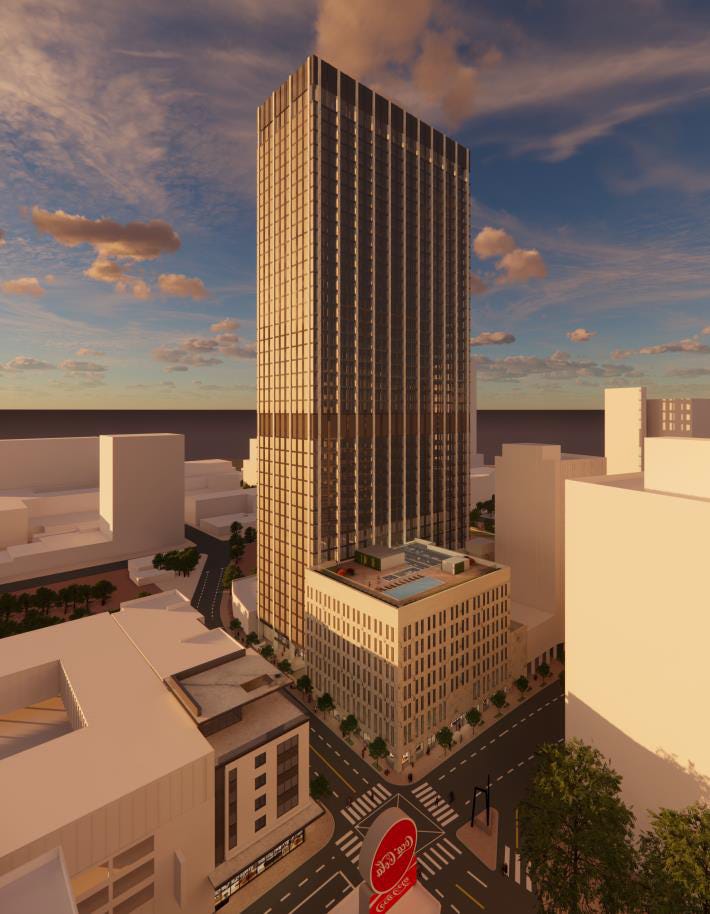
In Georgia, the Atlanta Urban Development Corporation (AUDC) has a number of projects underway utilizing this approach. One specific example is Mall West End, a currently under construction project planned to have 893 units with 30% rented out at below-market rates.3 Public developers in San Francisco, Seattle, and elsewhere have used this financing strategy as well.
So, it’s real and it works, but why should we care?
For starters, market-rate housing built by nonprofit developers can generate housing subsidies more efficiently than for-profit developers fulfilling an IZ requirement.
In an IZ regime, market-rate units not only have to cross-subsidize below-market-rate units but also deliver a competitive, risk-adjusted return to equity investors, meaning some of the potential subsidy is remitted to the project’s backers as profit. In contrast, a nonprofit developer doesn’t have equity investors expecting a return on their capital.
A nonprofit developer is also going to dial in the financially optimal mix of market-rate to subsidized affordable housing. Their purpose is to build subsidized housing, not maximize returns to shareholders. This matters both materially and politically. As a mission-driven public developer, they should be able to speak authoritatively and in good faith on how to maximize market-rate development as a tool for public subsidy. This should allay objections from advocates who sometimes believe there’s more subsidy to extract from profits than actually exists.4
Reverse inclusionary is also a financing strategy that cities can pursue without having to rely on the federal government. As it stands, subsidized housing in the U.S. is overwhelmingly a federal affair (the Low Income Housing Tax Credit program and Section 8 vouchers being the two major pillars).5 This means cities have to hope for good policy and competent execution from the federal government. In the best of times, we might want to equip cities to act independently. The times are, decidedly, not the best. The more we can set up cities to succeed on their own, the better.
Alright, now for the caveats.
First, I’m giving you a simplified version of reality to highlight something important and under-appreciated. As often as not, these projects include commercial development as well (see the Atlanta example cited above), so they’re not limited to making money off housing. They’re often also combined with other financing mechanisms like land leasing and tax abatements to help the finances make sense. So, there’s a lot more to say about public financing, but we’ll explore all of that in depth soon.
And while reverse inclusionary does provide a degree of freedom for municipal governments, it also requires that these same governments create competent development authorities capable of delivering market-rate housing at the same risk/cost profile as a for-profit developer.6 Good policy will always require effective execution.
Outro
Caveats aside, reverse inclusionary zoning (aka mixed-income development strategies) is something every urbanist and housing nerd should know about. In a world with runaway housing costs, subsidized housing production has a role to play. Not all forms of public finance are created equal and, unfortunately, just make the private sector pay more is an insufficient answer to the challenges that lay before us.
Ultimately, we need to reorient housing policy away from zero-sum extraction and toward value creation—whether by private developers expecting market returns or public stewards investing in the common good.
Postscript on Calculating Affordability
This is a brief note on how we think about subsidized affordability (for the folks slightly less steeped in housing policy).
Programs like IZ use something known as Area Median Income (AMI). This figure is calculated by HUD using American Community Survey data and is basically what it sounds like — the median household income for some geographic area.
To express affordability requirements in the context of IZ, we say (a) some percentage of the units in a building must be subsidized at (b) some percentage of the relevant AMI. For example, we could have a requirement that 25% of the units in a 100-unit building be reserved for renters making no more than 80% of local AMI.
Using San Francisco figures, the AMI for a single-person household in 2025 was $109,100; so a unit reserved for someone making 80% of AMI would mean someone making $87,300 or less. (Note that subsidies for folks making 120% of AMI are not unheard of as, in the country’s most expensive metros, these folks are still hard pressed to afford market rates)
So, all this matters because when we talk about means-tested housing subsidies, we have a trade-off between the number (#) of subsidized units and the degree ($) of subsidy. In our toy example above, providing 25% of the building’s units for residents at 40% of AMI (instead of up to 80%) would cost significantly more.
The Terner Center results are from a policy simulation model rather than observed construction outcomes. The model evaluates how inclusionary zoning requirements affect the financial feasibility of a large portfolio of hypothetical projects in the Los Angeles Transit-Oriented Communities context, holding zoning capacity constant.
I’m using reverse inclusionary zoning here for two reasons: first, “mixed-income“ as a term in the subsidized affordable developer community can refer to a broader range of things than what we’re discussing here today. Second, reverse inclusionary sounds cool.
In more detail, subsidies are means tested based on Area Median Income (AMI). In the Atlanta example, 20% of the units will be reserved for individuals earning 50% of Atlanta’s AMI and the remaining 10% reserved for residents earning 80%.
Admittedly, this doesn’t solve the issue of NIMBYs acting in bad faith. I do, however, believe it would make pro-housing politics easier all the same.
The federal government spends over $10 billion a year on supply subsidies through the Low Income Housing Tax Credit (LIHTC) program; it spends a similar amount on the demand side through Section 8 vouchers.
This often happens via a for-profit partner, so the public developer isn’t necessarily a 1:1 stand-in for a private developer.
Important piece with a clever proposal for financing more affordable housing
To some extent, LIHTC-subsidized “low-income” housing already recognizes the need for cross subsidy. Almost every LIHTC project includes housing at a range of affordability levels ranging from 15-80% area median income. The 80% AMI units are technically deed restricted, but they’re not too far from market rents, which helps finance the rest of the project
Which gets at another benefit of flipping IZ policies toward nonprofits: market-rate developers tend to provide IZ rates at the 80% AMI level, which doesn’t meet the needs of the most housing insecure people—in part bc market-rate developers really aren’t set up to provide the kinds of services those populations sometimes need. Encouraging mission-driven nonprofits to mix market-rate and affordable housing would likely produce IZ units with deeper subsidy level, managed by organizations that have experience providing sufficient onsite services to residents
Great article! Its become quite a good tool to convert existing public housing stock which is often very old into improved developments using the Rental Assistance Demonstration (RAD) program. RAD does not require market-rate units, but often comes with it. Use market-rate housing to develop new or improved developments on public housing sites, and remain the same number of HUD-assisted units.
I believe some of HOPE SF's project fall into this bucker.
I think we will see more and more Reverse IZ into the future