
The Fiscal Crisis Facing American Cities
The Future of Municipal Finance Part I

This post is Part I in our series on The Future of Municipal Finance in American cities.
Part 1: The Fiscal Crisis Facing American Cities
[LiveStream] Public Wealth for the Public Good with Dag Detter
Part 2: How Cities Can Pay for the Next Stage of American Urbanism
Part 3: Cities Need Their Own Urban Wealth Funds
American cities rely on money from Washington, D.C. Some of this is obvious, some of it much less so. But the federal fiscal regime that made this support possible is becoming harder to sustain. For decades, Washington could finance expanding commitments through debt without forcing immediate tradeoffs elsewhere in the budget. That era is ending.
Worse still, municipal exposure to a federal pullback is likely to manifest as what will appear to be fundamentally local failures. Residents who encounter deteriorating infrastructure, struggling schools, and shrinking public services will be unlikely to understand federal fiscal constraints. They will instead blame city hall.
US Sovereign Debt for Urbanists
For decades, the U.S. government borrowed money on uniquely favorable terms. The dollar’s status as the world’s post-WWII reserve currency gave the United States a borrowing advantage few other nations could match. Throughout the 2010s, interest rates were so low that there were seemingly no constraints on how much the federal government was able to borrow.1
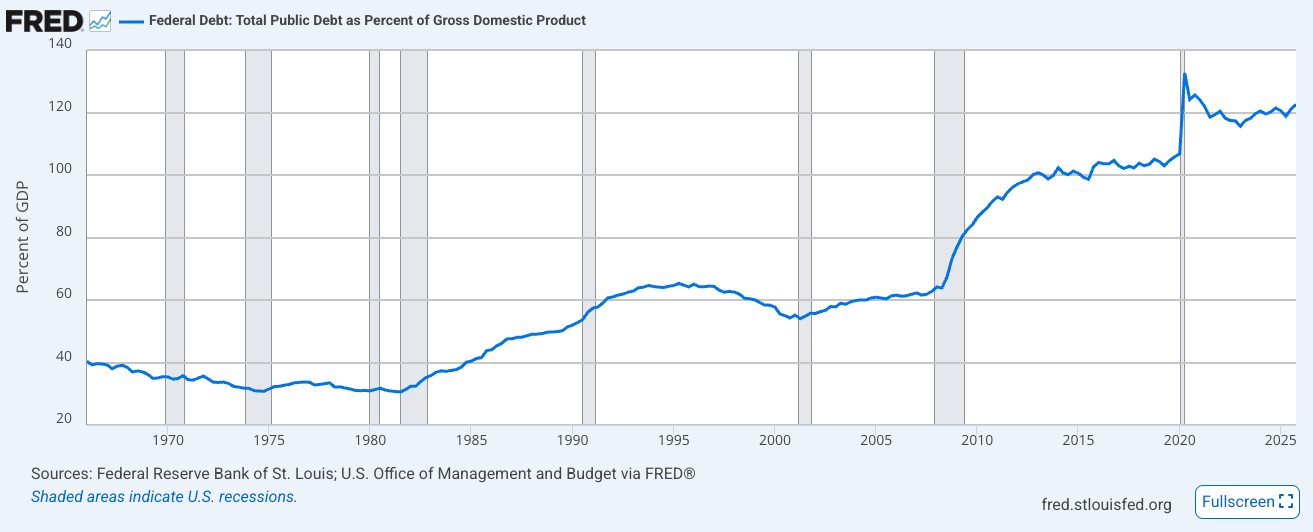
Then COVID happened. Emergency spending pushed the gross federal debt-to-GDP ratio past 120%, and the subsequent rise in interest rates has made that enlarged debt load increasingly costly to carry.2 Unlike previous debt scares — and there have been many — this one came with a structural change in borrowing costs. Interest payments on the national debt have already surpassed defense spending and are now on track to consume nearly a third of federal revenue within a generation.
At the Hoover Institution’s annual Monetary Policy Conference earlier this year, Stanford finance professor Hanno Lustig argued that Treasuries are beginning to lose their special status in international markets. Before 2020, investors accepted lower returns because Treasuries carried what economists call a convenience yield: a premium attached to their safety, liquidity, and money-like qualities. That premium, Lustig argues, has now disappeared, at least at the margin.
None of this means the United States is about to go bankrupt. But it does mean the era of easy fiscal choices is ending. As the cost of servicing the debt increases, Congress must borrow more, raise additional revenue, or devote a smaller share of the federal budget to everything else. Whichever path it chooses, the federal government will have less room to maintain the commitments on which American cities have come to depend.
How American Cities Are Exposed to a Fiscal Pullback
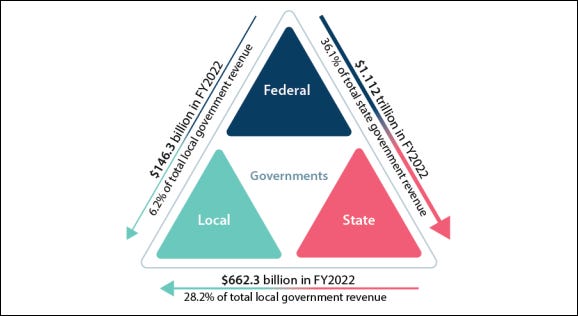
Federal money flows to cities in three flavors: direct transfers, indirect transfers, and what we call fiscal dark matter. Direct transfers are exactly what they sound like — money sent directly from the federal government to various localities. These include funds disbursed through programs like the Community Development Block Grant (CDBG), which supports things like public infrastructure and neighborhood services.3 In 2022, direct transfers like the CDBG totaled $146.3 billion.4 That’s significant, but actually the smallest of the three categories.
Less visible are the indirect transfers. These monies are initially awarded to state governments, which then allocate funds to municipal-level programs and services in accordance with state prerogatives. The cleanest example is probably K-12 education, which receives federal Title I dollars to pay for teachers and programs, but federal highway dollars work essentially the same way. All told, in 2022, the federal government handed down $1.1 trillion to state governments. That amounted to 36% of overall state revenue for that year and, depending on the individual state, ranged from roughly 22% to 50% of state revenue. How much of that ultimately flowed down to cities is hard to say, which is itself a problem: it’s difficult to even establish how exposed local governments are to a pullback in federal support of state budgets.
The third category – our fiscal dark matter – is all the federal money spent into local communities that never shows up in a local budget. This includes housing subsidies like the Low-Income Housing Tax Credit (LIHTC) and Section 8. It also includes food support programs like SNAP and even some direct funding for local food banks.
Rightfully or not, when the flow of federal money in this category starts to dry up, the resulting problems will fall squarely on the mayor’s desk. After all, the median voter is never going to see increasing numbers of homeless encampments and think to blame the head of HUD.
As bad as all that sounds so far, it may actually be much worse.
The “eds and meds” economies that anchor cities like Pittsburgh, Cleveland, and Baltimore depend heavily on Medicaid reimbursements and federal research grants to sustain the hospitals and universities that rank among their largest employers. Cuts there could precipitate layoffs in the institutions that have been holding together post-industrial downtowns for 30 years. And therein lies the second part of the dark matter problem. Federal money doesn’t just fund services and pay for infrastructure. In some places, it also props up major employers who anchor the entire local labor market.
All this fiscal dark matter is even harder to measure than our indirect transfers because, to my knowledge, it’s never been fully cataloged. Compounding this attribution issue is the fact that none of this will happen overnight. It’s far more likely this plays out little by little over time, like a fiscal tire slowly going flat.
What Comes Next?
The next era of American urbanism will be defined by financial precarity.5 Though we’re mostly prognosticating about the near future, in some ways, that future may have already arrived. The administration, in its infinite wisdom and beneficence, has decided to withhold billions in congressionally approved transit funding. It’s also denied requests for disaster relief in opposition-controlled states. So, even before Washington becomes unable to support American cities to the degree it once did, it may, in some cases, already be unwilling.
Returning to the larger structural issue, though, the world (and the U.S.’ financial place in it) has changed. As we enter an era of weakening federal backstops, municipalities will have to look to a different strategy to make ends meet. What won’t work, though, is simply doing more of the same harder. Most of the tools cities currently use to close budget gaps penalize the construction, commerce, and economic growth on which their future tax bases depend.
Thankfully, there is a better way forward. It’s one that will give cities greater control over their own fiscal futures and help insulate them from the vicissitudes of an increasingly unreliable federal government. But for that, we’ll have to wait for Part 2.
Emphasis on the word “seemingly.” Persistently low inflation—at least as measured by consumer prices—helped open a period of MMT-inspired debate over whether a currency-issuing government faced any binding financial constraint, as distinct from inflationary and real-resource constraints.
There’s a longstanding literature documenting the negative relationship between excessive debt-to-GDP levels and economic growth.
The CDBG supports a little bit of everything: housing rehabilitation, affordable housing development, water and sewer infrastructure, streets and sidewalks, community facilities, small business assistance, neighborhood revitalization, and various social service programs for low- and moderate-income residents. In practice, CDBG often functions as general-purpose community development funding for projects that local governments struggle to finance from local revenues alone.
For a sense of magnitude, CDBG funds can be in the millions to tens of millions of dollars for individual cities. Looking at HUD reporting data , San Francisco received over $18 million in FY’24. Los Angeles received $48 million and Chicago received $75 million in the same reporting year. So, meaningful amounts, but small compared to city budgets that can run into the billions.
Credit where it’s due, Charles Marohn over at Strong Towns has been making the case that we’ve been living in an era of financial precarity for a very long time. And although I’m making a different argument from his Growth Ponzi Scheme thesis, hats off to him for being ahead of the curve on this conversation in the U.S.