
How Charlotte convinced homeowners to build more housing
Literally in their own backyards

As YIMBYs continue fighting the good fight, we’re increasingly working to rewire the political-economy that makes that battle so hard in the first place. I recently wrote about how the city of Falls Church used land leasing to buy off the NIMBYs. Laura Foote has also highlighted a proposal to have the federal government simply hand out cash to cities for allowing housing production. Today I have another example for you in the same vein: the Charlotte, North Carolina Queen City ADU Program.
This is a story about a program solving a few different problems at the same time. For starters, the city not only made new housing types legal, they made them financially viable. The program might also be one of the most efficient uses of public housing subsidies I’ve ever seen. And, last but not least, policymakers managed to turn incumbent homeowners into supporters of subsidized affordable housing, literally built in their backyards.
Paying homeowners to be YIMBY
Charlotte is the largest city in the state of North Carolina. It boasts a population of over 850,000 and is home to one of the largest concentrations of financial services firms in the U.S (losing out only to New York City). Unfortunately, like most other major metros in the U.S., it also has a housing crisis.1 Fortunately, policymakers out in Charlotte have been hard at work trying to confront their rising housing costs.
In June of 2023, Charlotte upzoned residential areas throughout the city. ADUs, duplexes, and triplexes were re-legalized, complete with by-right permitting. In 2025, policymakers decided to go a step further. They wanted to ensure what they’d made legally possible would be financially feasible as well. Enter the Queen City ADU program.
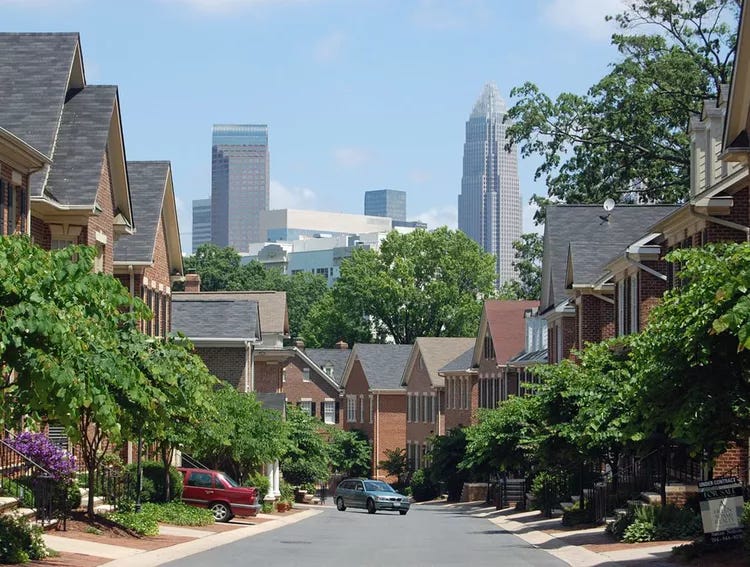
The program provides home-owners with 0% interest loans to finance the construction of ADUs.2 Loan amounts are for half the construction costs (up to $80K) and given ADUs in the Charlotte market cost something on the order of $90,000 to $250,000, the loan covers a significant portion of the expense.3 Of course, there’s no such thing as a free lunch, so the money comes with strings attached.
To qualify, the homeowner must sign a deed restriction that locks them into the following requirements for 8 years:
Rent the ADUs to residents earning no more than 80% of the area median income
In Charlotte, that’s $62,850 for a single person or $89,750 for a family of four
Charge no more than $1,099 a month
i.e. the Fair Market Rent for a studio at 70% AMI
Accept Section 8 tenants
Discrimination against renters paying with vouchers blunts the effectiveness of the program
Suffice it to say, this program is thoroughly based and utterly casita-pilled. But let’s talk about why.
Missing middle is difficult to finance. Real estate lenders like to lend to things they understand and, for them, understanding means having enough historical examples of similar projects to confidently estimate risk-adjusted returns. As it turns out, making the missing middle illegal in most places for half a century has created a bit of a chicken or the egg problem.4
By providing access to credit for at least some of the newly legalized housing products, the city of Charlotte is making ADUs not just legally permissible, but also financially viable. And as Andrew Burleson has pointed out to me, public funding of missing middle housing products might create the data that lenders need to get in the game themselves. I suspect this would happen organically over time, but this feels like a place where public investment can jumpstart the process and pull the future forward by years if not decades.
This program is also awesome for being such an efficient use of housing subsidies. According to the UNC School of Government, the average unit of subsidized affordable housing can cost over $240K in subsidies to create. That’s 3X the amount the city will spend to create a new unit of housing through their ADU program.5 None of that is a knock against affordable housing developers, mind you. Land acquisition is a major cost for any type of real estate development, so getting homeowners to build on land they already own provides significant cost savings.
Like we’ve discussed before, homeowners have a thousand reasons to oppose new housing. The incentives that Charlotte’s ADU program creates, though, is a great way to erode NIMBYism’s structural cartel. In practice, NIMBYism is really about other people’s backyards. As soon as you give someone the ability to defect and actually build something on their own land — something that puts cash in their pocket and increases their home equity value — people get real excited about their property rights real fast. For as much work as there is to do re-weighting local politics away from NIMBY capture, when we can make new housing tangibly, materially benefit individual homeowners, we can bring them over to our side of the debate.
Thoughts and Takeaways
On the whole, Charlotte’s Queen City ADU program is a fantastic idea and I’d hope to see more programs like this pop up in cities across the country.6 Before we break, though, I want to offer my own thoughts.
I would love to see a graduated structure to increase enrollment. We could imagine a homeowner getting a $20K grant for a 4-year affordability commitment, $60K for 8-years, and $100K for 10-years, with the option to decide to stay in the program at the end of each preliminary term.7 I think this could get more homeowners to make the initial commitment and create incentives for them to continue for a few more years (rather than forcing the larger commitment up front).
I’d also love to see this dual liberalization + financing combo plate turn into a true policy value meal with the addition of a split-rate property tax.
Split-rate property taxes split apart taxes on buildings and land, reducing rates on the former and offsetting the discount by increasing them on the latter. So, instead of a 1% traditional property tax, it might look like a .5% tax on buildings and a 2.5% tax on land.
Reducing tax rates on buildings would remove a disincentive to build. Right now, adding an ADU immediately increases home equity values, but it’ll also increase the homeowner’s property tax bill at the same time. So, split-rate reforms would solve the problem of tax policy and housing policy working at cross purposes.
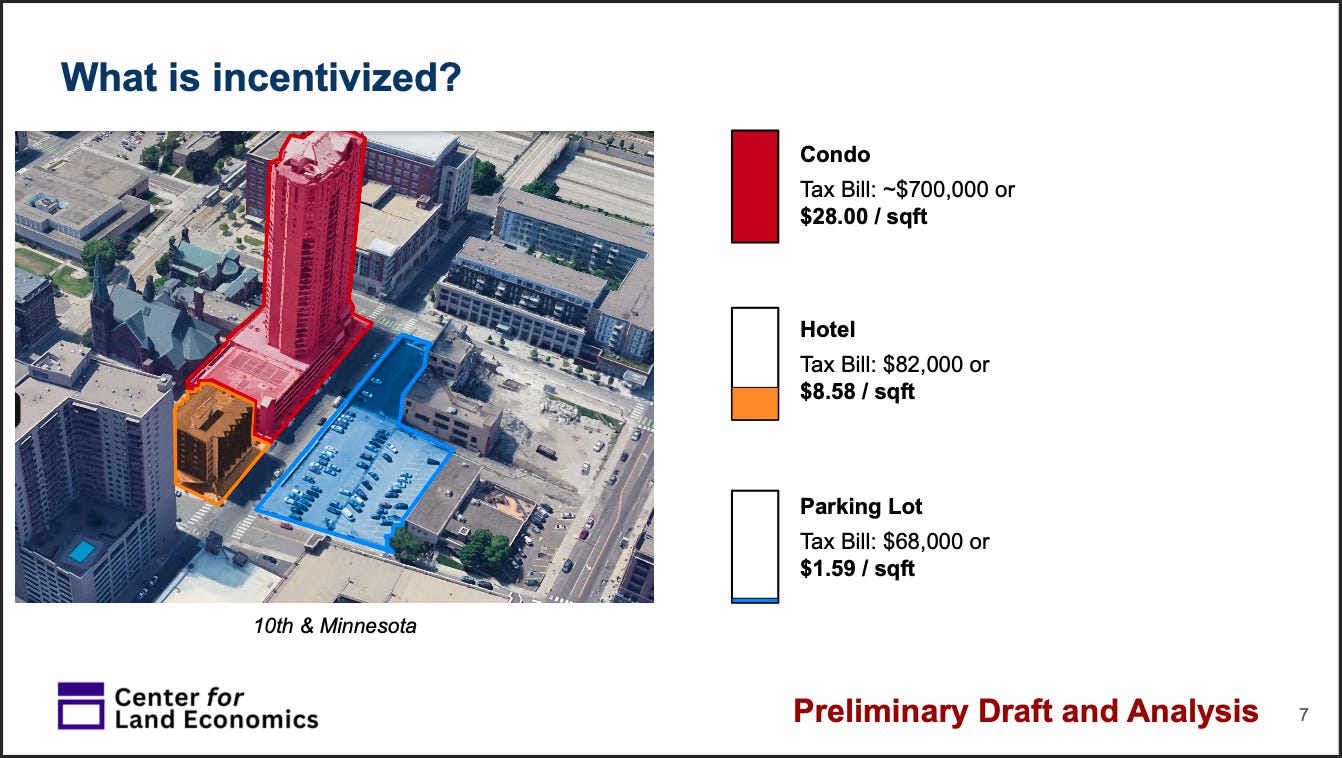
At the same time, increasing the tax rate on land would raise significant revenue. Even if the tax shift from buildings to land is a wash from the perspective of homeowners, a city still get extra revenue from increasing taxation on vacant lots and valuable downtown surface parking.8 This immediate bump in revenue is then available to fund our subsidy program for infill development in lower-density residential areas.
Policy riffing aside, the Queen City ADU Program is exactly the kind of program I want to see cities across the country trying out. Obviously, just bringing financing to bear is a big deal, but, for my money, the effect on the local political-economy remains the most exciting part.
For as much as we need to continue contesting the power to say no to new housing, there’s so much work we can still be doing to change attitudes toward development in communities across the country. Culture is always and everywhere downstream of material conditions; when we use policy to change those conditions, we change the culture that reflexively resists healthy development. Giving people a stake in their communities has to mean letting them get a piece of the upside from change. That’s why I’m excited about what Charlotte is trying out and will be following their progress with the highest of hopes.
The scale of the affordability problem is easier to see when you compare home prices to incomes. According to Census ACS data, the Charlotte MSA's median household income grew from about $66,400 in 2019 to $85,900 in 2024 — a respectable 29% bump. Over the same stretch, the median home price in the metro went from roughly $225,000 to $443,850, according to the UNC Charlotte Childress Klein Center's 2025 State of Housing report. That's 97% growth — more than three times the pace of income gains. Put differently, the price-to-income ratio went from about 3.4 to 5.2 in six years. That's not San Francisco-bad, but it's indicative of a place facing the choice between building more housing and choking on its own success.
Functionally, this is a grant. It's legally a loan so that if anyone breaks the terms of the deed restriction that accompanies the funds, the city has a straightforward way to claw back the money.
If you’re squinting at that price range, let me show my work. That initial range is from Axios reporting. I also found a pre-fab ADU company in North Carolina quoting new builds at $120-$220K. Another builder quoted cost at $50K (for garage conversions) - $120K.
Because there are so few parcels in so few places that allow for missing middle, when something does get built it’s usually because a small local builder was able to get financing from someone’s rich uncle who owns a car dealership and can cut the odd $400K check. So, although it’s not literally impossible to fund these types of projects, the capital markets that ought to exist to finance them are quite thin.
Now, we could quibble and say that the typical subsidized affordable unit stays affordable for 30-years, so it’s actually a more efficient use of public funds; as David Deek points out, though, ADUs are just easier to get financed, permitted, and built (whether we’re talking market-rate or not).
Credit where it’s due, this looks a lot like Chuck Marohn’s Micro-TIF idea for financing incremental development.
Keep in mind these numbers are completely arbitrary. The loan/grant amount, degree of affordability, and duration(s) of the commitment would all depend on local construction costs and the amount of subsidy available to the program.
Longer-term, a land-centric tax policy also encourages greater economic growth on the whole by encouraging the productive use of land. It’s a policy that generates more revenue now and even more revenue later.
On the topic of "most efficient use of subsidies to create affordable housing," I've been thinking a lot about this pilot program between Padsplit and the city of Portland: https://www.portland.gov/phb/home-sharing-pilot-program
It gives a $1000 bonus to homeowners who list a spare room as a rental property (has to be $800/month or less), plus an extra $500 for each additional room.
Granted it's Portland and it remains to be seen how well it works, but theoretically this could unlock hundreds of affordable SROs at a fraction of the price of an equivalent number of new apartments, or even ADUs.
Thoughts?
The SUPERMAJORITY PLAN TO IMPEACH TRUMP and HIS ADMINISTRATION
It will take 292 house and 67 senate votes to obtain a supermajority vote. This is the key to accomplishing anything in the house or senate. The house and senate will be able to impeach Trump and his administration for their crimes and corruption.
The Democrats are the only ones that will stand against Trump. We have to vote out as many republicans as possible.
EVERYONE IS GOING TO HAVE TO VOTE FOR DEMOCRATS IN THE NOVEMBER 3RD MIDTERM ELECTIONS TO MAKE THIS WORK
Make sure you share this with everyone you know without social media. People without social media are unaware how corrupt and detrimental Trump’s administration really is for our country. The media outlets do not post anything negative about Trump. Some people don’t even know what the midterm elections are or how important they are.
TRUMP, HIS ADMINISTRATION, HIS BILLIONAIRE PEDOPHILE NETWORK (Elon Musk) , AND THE REPUBLICAN PARTY ARE MAKING IT IMPOSSIBLE FOR THE WORKING CLASS TO SURVIVE.
WE HAVE TO STOP THEM FROM DESTROYING THE COUNTRY