
How a city used land leasing to buy off the NIMBYs
Changing the players by changing the game

A hundred years of bad land use policy has suppressed housing production in our metropolitan cores. A core problem with fixing this failing system is that it’s not failing everyone. Incumbent homeowners prefer the status quo, which is why they use local political systems to block new development.
This characterization is mostly accurate, but it’s also slightly reductive because it implies that the only way to overcome NIMBY sentiment is to directly overpower it. While that’s certainly one tack, there’s more we can do. We can make the fight for housing abundance easier to win not just by renegotiating the political rules of the game, but also by reconfiguring the underlying political economy that creates so much hostility to new housing in the first place. More plainly, we don’t have to beat all the NIMBYs; we can get some to join us. And because I love a good case study, we’ll be taking a look at the example of Falls Church, Virginia.
Why Falls Church turned to land leasing
Falls Church is a two-square-mile community tucked away in the northeast corner of Virginia, just a few miles outside the U.S. capital in D.C. The city traces its origin all the way back to 1734, though it incorporated as an independent municipal entity in 1948.1
In 2017, the town decided to rebuild the local high school. The existing facilities were built in the 1950s, and the cost of maintenance was becoming so high that it was more economical to rebuild the facilities from scratch. The city had two options:
Option A: increase everyone’s property taxes by $1,050
Option B: use 10.3 acres of publicly owned land for redevelopment, monetize through land leasing, and only raise everyone’s property taxes by about $280.
After a voter education campaign and a series of public hearings, the council moved forward with option B.
When the city rebuilt the local high school, they sectioned off a portion of the land (labeled “West Falls” in the image below) and transferred ownership to the newly created West Falls Community Development Authority (CDA), essentially a subsidiary of the municipal government in charge of managing the project on behalf of the city. The CDA was empowered to issue bonds and enter into a lease agreement with a development partner, eventually choosing FCGP Development LLC.
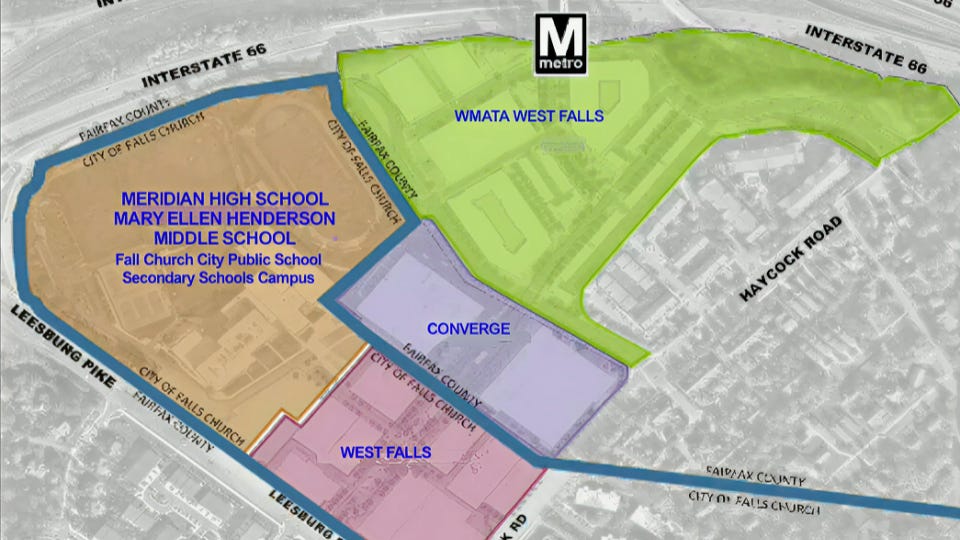
The CDA structured its agreement around two lump- sum payouts, plus a yearly lease fee, and eventual repossession of the land and all improvements at the end of the lease term.
Phase 1 payment: $25.5 million (roughly 57% of the land’s assessed value) paid out over the first six years of the lease. Grants developer rights to build on most of the property (3 acres held in reserve).
Phase 2 payment: $10 million or the assessed value of the reserved 3 acres (whichever is greater), payable after the Phase 1 completion. This structure ensures the CDA captures any unanticipated land appreciation.
Annual lease payments: Annual lease payments starting at $200,000 and increasing 2% annually, with a one-time $25,000 step-up in 2030. Payments starting in 2026.2
Repossession of land and improvements: The final cherry on top comes at the end of the lease period. Barring renegotiation, everything FCGP Development has built defaults to CDA ownership.3
Arguably, this deal structure’s monetization strategy is less based on the yearly lease payments as it is enabling the city to resell access to the same pieces of land every generation. Details aside, the city retains ownership of the land and is able to monetize increasing land values in perpetuity.
How land leasing made housing popular
Ok, back to buying off the NIMBYs.
At the most fundamental level, NIMBYs are NIMBYs because they prefer the status quo. Individually, that could have to do with banal issues like the aesthetics of their neighborhood or unpriced street parking. It could also include resource concerns like the availability of free street parking or school crowding. More darkly, racial and class animus might also be at play.
So, our problem is twofold: NIMBYs don’t believe change benefits them personally and local government overweights the preferences of the typical NIMBY. While there’s been a lot of work done on the latter part of that problem, the Falls Church land leasing story is a great example of the progress we can still make on the former.
The West Falls plan includes over 850 units of housing situated within a larger mixed-use development. That’s roughly 100 units per acre as part of a project with a 15-story height limit. For comparison, the typical American suburb is about 3-5 units per acre.
And lest we imagine that Falls Church homeowners are just magically YIMBY, the same underlying concerns, like traffic and competition for public services, were present. That said, proponents of the project in the City Government consistently messaged the West Falls Development as a solution to the financial challenges of rebuilding the school.
At the project groundbreaking, the city’s mayor remarked:
It started with a challenge. How are we going to replace and modernize Meridian High School without burdening our taxpayers? And the answer was bold. Pair the school construction with redevelopment of this 10-acre land so that new private investment could help make possible the financing of a state-of-the-art high school for our students.
The City of Falls Church made the West Falls project politically palatable by making it something that let residents move toward a thing they wanted (a new school) and move away from something they wanted to avoid (significantly higher property taxes).
It’s worth pausing for a moment to imagine the counterfactual. As we mentioned at the top, school crowding is a common reason for residents to oppose new housing. So, turning a desire for school quality from a reason to oppose housing into one to support it is no small feat.
In Falls Church, the city used land leasing to present voters with a set of tradeoffs between housing development, public school renovation, and property tax rates. This “you can only pick two” scenario made the policy choice highly legible and, ultimately, skewed the decision in favor of more housing. Municipal land leasing facilitated this by separating land ownership from building ownership. Instead of selling public land outright, the city retained ownership and leased the land to a private developer (in this case for 99 years). The developer financed and constructed the project, while the city captures value through lease payments and eventual reversion of the property. This allowed the city to efficiently monetize the upside from growth and parlay those resources into a desired public good.
So what’s the takeaway?
The mechanism generalizes, not the specifics — any municipality with publicly owned land and a pending capital expenditure has the raw ingredients for a similar structure. The ingredients here are (a) an effective way to monetize the upside from new development, (b) a tangible, popular public need, and (c) effective messaging to tie (a) and (b) together and present voters with a legible set of tradeoffs.4 Falls Church had a school; another city might have a library, a park, a community center, or deferred infrastructure maintenance. In California, we may even see this take off with underutilized land owned by the state’s two university systems.
Much of the energy behind NIMBY resistance comes from the belief that change threatens the things people value — their parking, their schools, their neighborhood stability. When incentives are structured differently — when development is clearly tied to things residents want or costs they’d rather avoid — that resistance weakens. Municipal land leasing is one way to create that alignment. By enabling cities to better capture the upside from development and connect it to tangible public benefits, it can turn housing growth from a perceived loss into a shared gain. It doesn’t eliminate the politics of housing, but it can make those politics far easier to win.
The town’s backstory is about as racist, classist, and exclusionary as most of American land use, which is to say, very. I’m given to understand the existing city leadership is intent on reckoning with that past in various ways, perhaps the most tangible of which is through pro-housing land use policy.
This mechanism puts the onus on the developer/lessee to monetize the land fast (and successfully) enough to stay ahead of the payment schedule. In the Falls Church example this fee is low enough (relative to the lump sum payments) that I doubt it’s determinative, but it’s an interesting way to approach pricing strategy for land leases.
This part likely sounds more radical than it actually is. Most commercial developers assume a building will fully depreciate over the course of 20-30 years; over the life of the West Falls lease, there will likely be a couple rounds of development, with monetization/depreciation timed to coincide with the expiration of the lease. The important point is that the city retains control of the land and has the incentive to continually monetize it (i.e. keep it in productive use).
There are also other reasons to like municipal land leasing that go beyond questions of housing abundance.
This municipal land leasing approach sounds like a land value tax framed another way.
Generally speaking, it is easier to get things done when you can show folks a good trade-off. This is a nice example.