


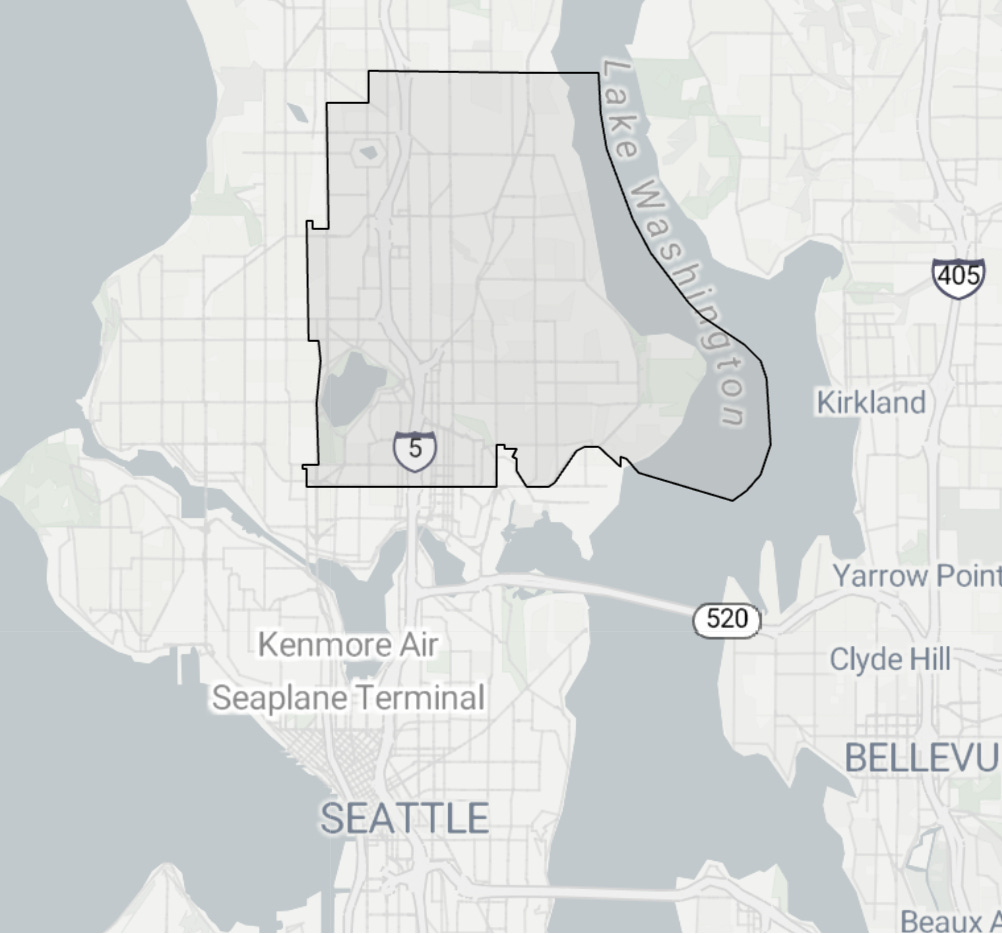
Ron Davis is running to represent Seattle’s 46th District in the Washington State Legislature. He has an eclectic bio (working-class family, Harvard Law, B2B software sales), an impressive command of policy (we went deep on elevator reform), and a style of politics (outcomes > process) that I hope to see more of.
Full disclosure: I’ve donated to Ron’s campaign; if you find this interview compelling, I hope you’ll also consider supporting him as well.
Who is Ron Davis? [00:01 – 00:03]
Ron’s story begins in 1980s Seattle. His parents eventually made it into the middle class through his father’s unionized factory job and housing that was cheap enough to provide the family a foothold. Ron argues, however, that this path is no longer available to families in Seattle today.
Parking Reform: From MAGA to Marxist [00:03 – 00:06]
Ron’s political experience includes both state and local advocacy. Working with Sightline, he helped with one of the largest parking-reform bills ever passed in Olympia. As Ron tells the story, they started the campaign with nearly every legislator calling it dead on arrival. By the end of the effort, they managed to pass the bill with a coalition spanning “MAGA to Marxist.”
Upzoning is great, but have you ever tried reforming building codes? [00:08 – 00:13]
Remember when we said Ron goes hard on policy? Let’s start with building codes.
Ron points out that an elevator in New York costs roughly 4X as much as an elevator in Switzerland. This is partly because American building codes mandate elevators large enough for a double-wide stretcher with an attendant lying flat. Washington’s recent reform narrowed that requirement to what’s explicitly required by the Americans with Disabilities Act, saving $15,000–$20,000 per elevator and shrinking shafts enough to recapture floor area as housing.
Who says YIMBYs never talk about finance? [00:13 – 00:22]
In a high interest rate environment, finance is tricky. Ron sketches out a three-part playbook:
socialize inclusionary zoning costs through a Portland-style abatement
deploy public revolving loan funds, building on Paul Williams’s work, to substitute cheap public debt for expensive equity in approved projects
enable cities in Washington to adopt land value taxation via tax abatements on buildings (something he worked on as an advocate with Sightline)
This is one of the best parts of the discussion. Ron has clearly thought through the finance question from every conceivable angle and come away from the process with a raft of ideas we should be thinking about.
The opposite of car-brain [00:25 – 00:35]
On transportation, Ron wants to change the OKRs of transit planning, build a world that frees us from car-dependency, and empower agencies to actually build the transit they’re charged with providing.
State DOTs evaluate road projects on throughput while ignoring things like induced demand, emissions, and vehicular deaths. Ron wants to shift the way we evaluate road projects such that we account for the costs and, ultimately, choose to do other things.
Cars take up too much space. There’s a reason cities like Vancouver, or countries like Denmark and Japan look and function the way they do: the environment isn’t built around the primacy of the single-occupancy motor vehicle and that gives people other options.
On the topic of mass transit, Ron goes as far as to argue transit agencies — or at least the region’s major agency, Sound Transit — ought to be able to self-permit their own projects as a way to escape fighting with every individual municipality through which it’s trying to extend service.
Maybe it’s bad that we let everyone sue everything [00:35 – 00:40]
Pressed on the Dunkelman problem — how a polity that has institutionalized vetocracy can find its way back to doing things without just handing over the reins to the next Robert Moses — Ron offers a procedural answer rather than a philosophical one.
The American system rarely grants a formal veto; what it grants is a process dense enough that it becomes easy to be non-compliant, plus standing to sue over the inevitable slip-up any project will make. Crowdsourcing compliance via private lawsuits is, in fact, a bad system. California’s CEQA exemptions for infill are the template.
Left Abundance? Sewer Socialism? Whatever it is they do in Scandinavia? [00:40 – 00:47]
On politics, Ron distinguishes himself from both technocrats and from a version of the left that’s too often indifferent to whether things actually get built. When I asked him whether his approach was some cool, new third thing, his response was…not really.
He likened his style to a revived “sewer socialism,” or “the New Deal without the racism.” His politics are materialist. Legitimacy comes from delivering tangible goods to constituents. At the end of the day, it’s about government actually doing things that matter to normal people.
His general guidance when talking to constituents: explain how you’re going to address their problems, but don’t be a walking PowerPoint or a condescending know-it-all.
Why Washington, Why Seattle, Why Ron [00:47 – 00:53]
Washington matters because it is among the few blue jurisdictions far enough along on housing to test whether a different Democratic offer is viable — one that delivers visible competence to working people without the condescension associated with the party's recent vintage.

Within the larger context of Washington State, Seattle is a testbed for a pro-housing progressive agenda. The city is already a national exemplar on housing issues and every policy win there is a policy example for everywhere else. It’s the laboratories of democracy idea, scaled down to the level of municipal urban reform.
As for Ron himself, he’s campaigning to unseat an old-school NIMBY incumbent. If he flips the seat, he replaces an anti-growth legislator with not just a marginally better elected, but the total opposite.
Thank you Rhishi Pethe, Greg Miller, Lars Doucet and many others for tuning into the conversation.


