
How Cities Can Pay for the Next Stage of American Urbanism
The Future of Municipal Finance Part II

Part 1: The Fiscal Crisis Facing American Cities
[LiveStream] Public Wealth for the Public Good with Dag Detter
Part 2: How Cities Can Pay for the Next Stage of American Urbanism
Part 3: Cities Need Their Own Urban Wealth Funds
In our last episode, we explained how U.S. cities rely on federal financial support and why that support is likely to diminish in the near future.
To recap, federal money shows up in local communities through direct grants to city governments, indirect grants that first flow through state budgets, and invisibly as fiscal dark matter that supports a range of things without ever ending up on a municipal balance sheet. The increasing U.S. federal debt load, along with the erosion of Treasury debt’s privileged status, means that the level of federal support for local spending will begin to erode and cities will be forced to adjust.
So, that’s the challenge we face in the next stage of American urbanism. This week, we’ll discuss what cities can do about it. But first, context.
Where to find the money for the next stage of American Urbanism
Let’s start with a distinction that gets buried in everyday conversation about real estate: when we talk about property values rising, we’re almost never talking about buildings. Buildings are consumer durables, like refrigerators or cars — they start depreciating the moment they’re built.
When real estate prices rise, it’s the land, as distinct from the structures on top, that’s becoming more valuable. In America’s most productive metros, land alone can account for up to 60% of the median property’s total value. But when we say land value, we’re not literally talking about dirt and gravel. We mean location. And what makes a location valuable is everything it gives you access to.
As more people cluster in a city, it becomes increasingly advantageous to be there. On one level, it’s a labor market story: employers, workers, and customers co-create deep local labor markets that make all the participants materially better off. Less bloodlessly, cities as clusters of labor and capital give rise to the urban culture and social ties that draw people to a place as well.
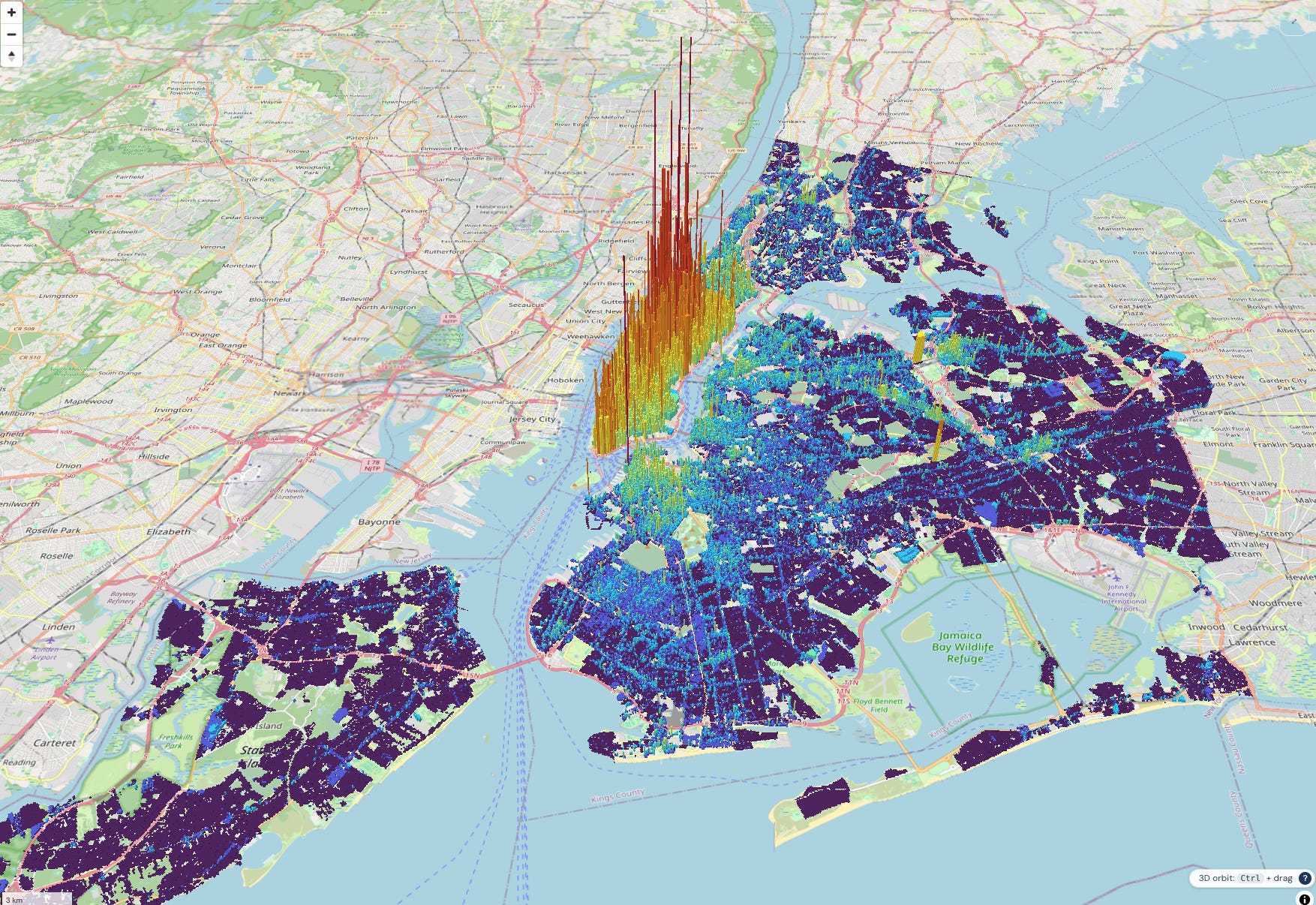
Municipal government has a unique and vital role in this process. City-wide services like sanitation and law enforcement are prerequisites for the economies of scale that urban growth requires. Location-specific investments like transit stops, parks, and public schools create place-based amenities that increase demand to live nearby, thereby driving up land values. For a concrete example, the increase in land value generated by a single Bay Area Rapid Transit station would have been enough to pay for the cost of the extra station five times over. That’s how much value well-deployed public infrastructure can create.
The implication is straightforward, if underappreciated: land value is not something landowners create. It’s produced collectively — by everyone who shows up and makes a city worth being in, and by the public institutions that make it possible for them to do so.
Land values — created by the community but nurtured and cultivated by effective city government — are exactly what municipalities ought to tap to fund the vital work they do. And in a world with less reliable federal support, this is no longer just a good idea. It’s the only navigable path forward for American municipalities.
Land Monetization Strategies
There are roughly two good ways for cities to monetize their land values: taxing private land and leasing public holdings. We’ll address each in turn.
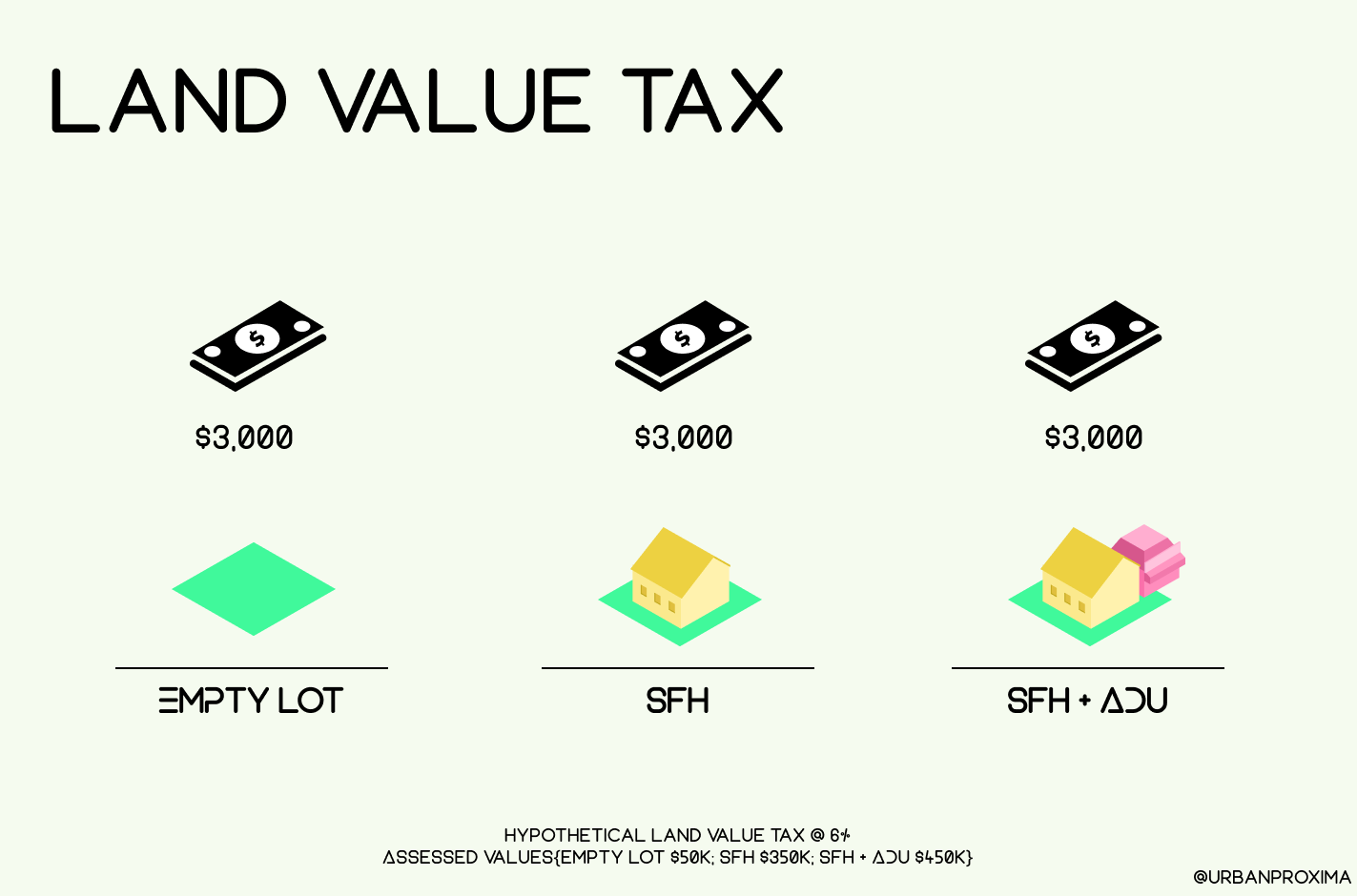
A pure land value taxation (LVT) works like a property tax, but only applies to the value of a parcel’s land (i.e., it doesn’t tax the value of any buildings or infrastructure on top). So, if you own a $350,000 property where the land component is worth $50,000 (and the building is valued at $300,000), an LVT would only tax you based on the $50,000 value of your land.
All else equal, a vacant lot and a parcel with a building get the same treatment. In an area where land has become valuable, it incentivizes denser development and disincentivizes leaving expensive land idle or underutilized.
There are a couple different ways to implement this policy in practice.
An LVT tax shift, as popularized by Greg Miller and Lars Doucet of the Center for Land Economics, would be a sea change all on its own. The basic idea is to separate the tax rate on land from the rate on buildings, raising the rate on land and lowering it on buildings. Politically, the trick is to strike a balance such that homeowners pay the same as(or less than) they did under a vanilla property tax regime. This makes the policy easier to pass politically and insulates it against an after-the-fact tax revolt, something that’s always a danger in homeowner-dominated (American) local politics.1
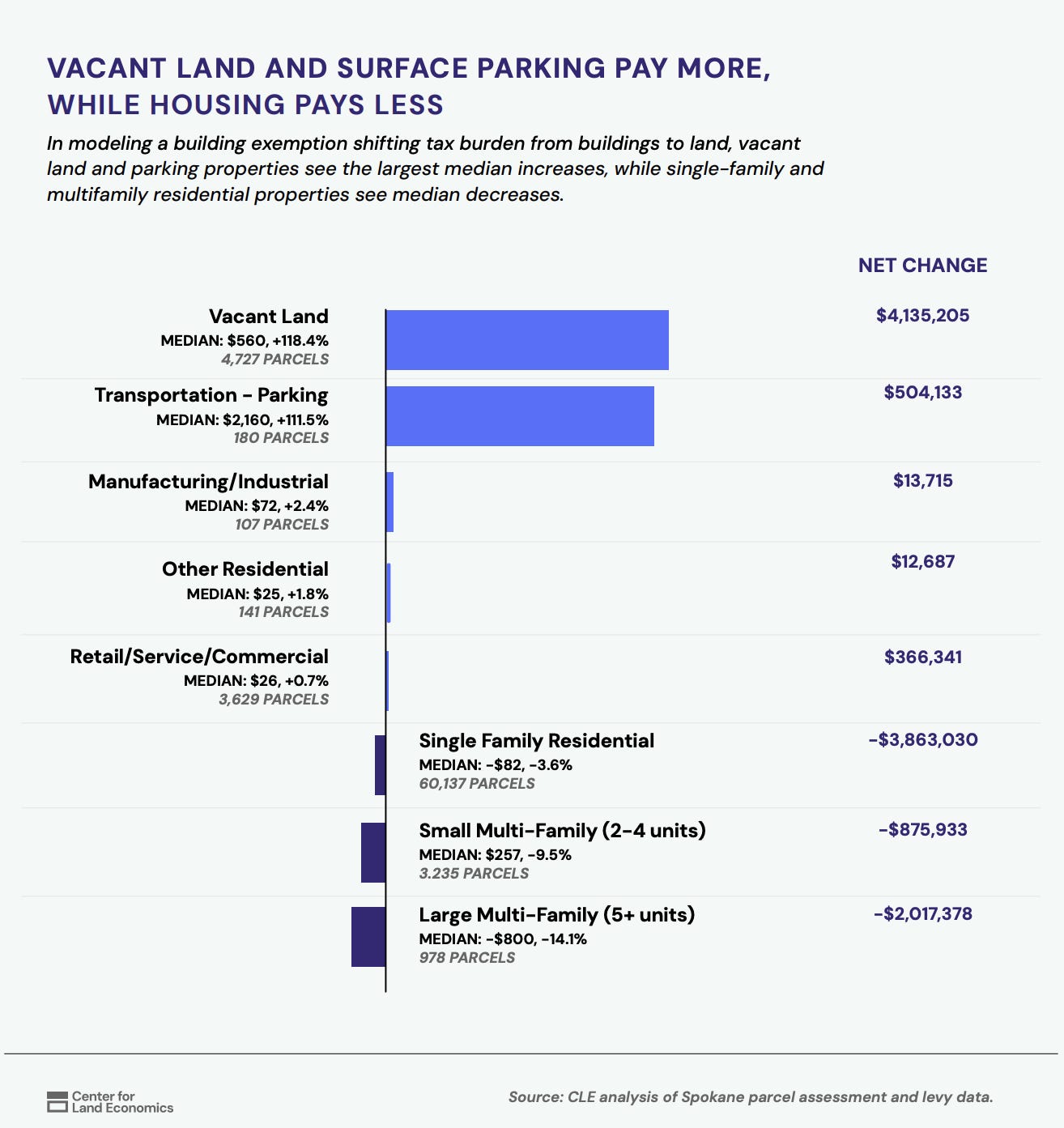
In the short term, a sufficiently aggressive tax shift could increase net revenue by increasing taxes on vacant lots and valuable urban-core land used for surface parking, two things American cities have an overabundance of.2
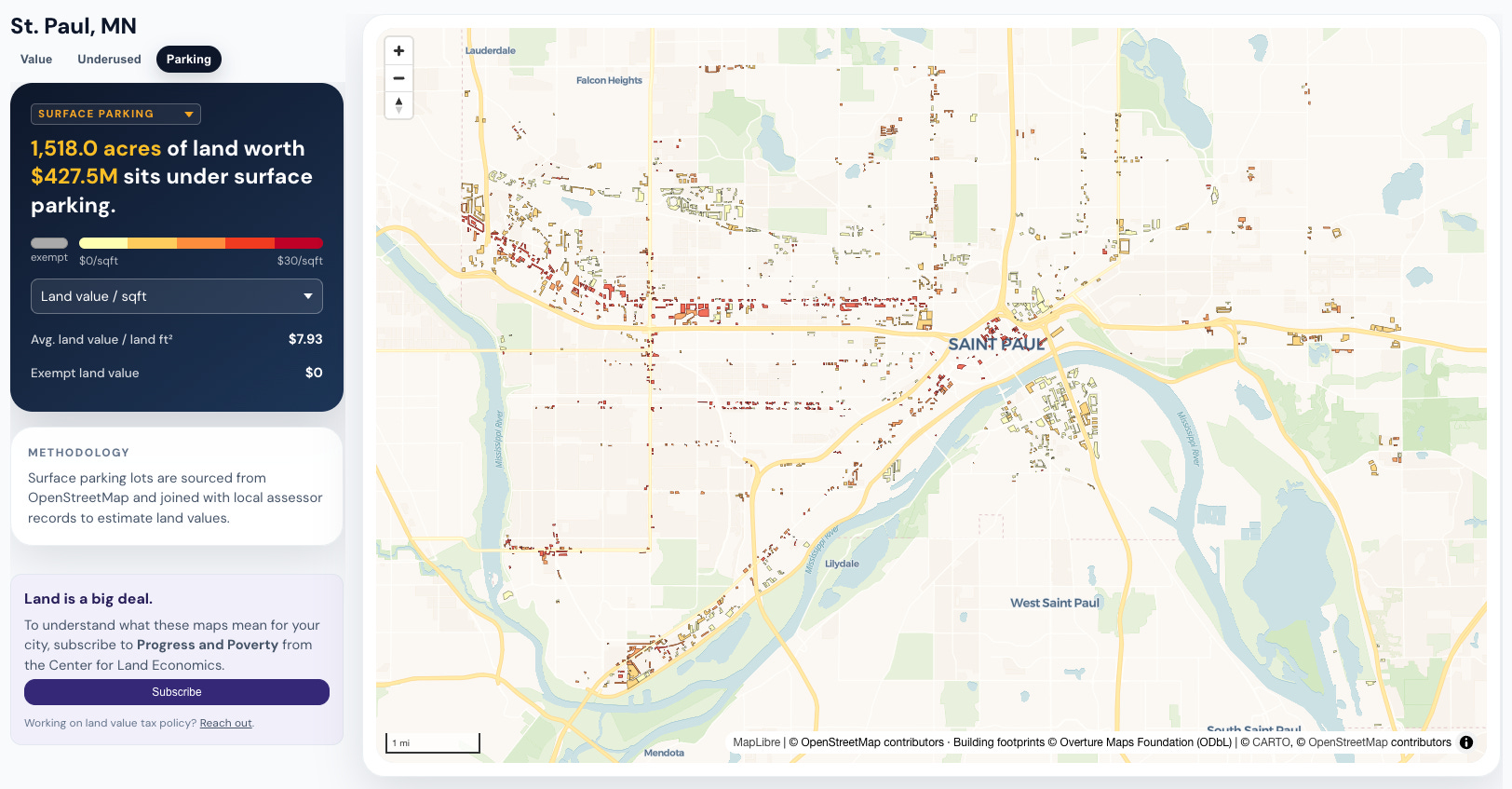
Over the medium term, putting land to more productive use will generate more revenue even under existing tax regimes. For example, turning a surface parking lot into a multi-story mixed-use development generates sales taxes (whereas the surface parking lot does not). The consulting firm Urban3 has made the case that denser development produces higher tax returns per acre (relative to infrastructure costs), even under a tax regime that relies on a more typical mix of sales and vanilla property taxes.
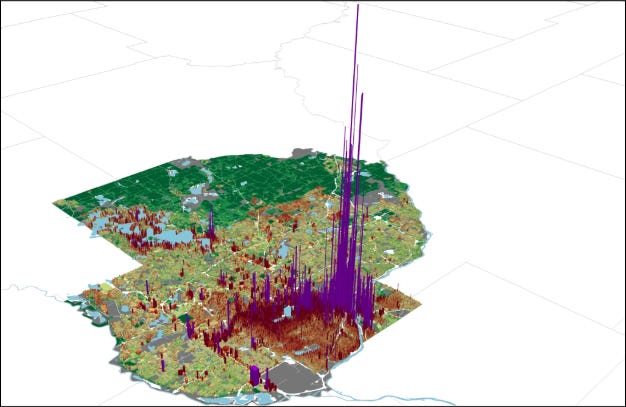
Over the long term, we’re simply looking at more people being able to congregate in a city more easily and do business more readily. That ongoing economic growth further boosts land values, allowing public revenues to grow along with the city’s economic growth.
And before the skeptical reader files this all away as some fanciful pipe dream, this year Virginia and Kentucky passed legislation to allow their cities to opt into this type of tax regime.3 The state government of New York just authorized New York City to create a special land value tax district to pay for the new IBX line, the city’s first rapid transit line in nearly a century. As a policy tool, it’s far less exotic than it might seem and quickly becoming re-embraced by policymakers across the country.
The other tool cities have to monetize land value is municipal land leasing. Unlike LVT, which recaptures land value of privately owned land, leasing allows municipalities to monetize the value of publicly owned parcels.
As the name suggests, municipalities lease out public land for private development. This positions a city government as the final landlord in the real-life game of Monopoly and ensures that public land generates revenue for public use in perpetuity. Not all leasing systems are built the same, though, so it’s worth talking through some of the distinctions.4
My favorite American example is Battery Park City in NYC. All the land in this lower Manhattan neighborhood is owned and overseen by the Battery Park City Authority, which, among other sources of revenue, collects ground lease fees from the real estate developers who’ve built out the area. These leases typically include periodic reassessment, so as the land has gotten more valuable over the decades, the authority’s leasing proceeds have grown with the increasing size of the pie.
Another great American example is the West Falls Development in Falls Church, Virginia. Back in 2017, the city decided to develop a few acres of public land to pay for a new public school. Instead of selling off the land, they decided to retain title and partner with a developer to build out the area under a lease agreement. While this is similar to the Battery Park City example — there is an ongoing yearly payment made to the city — the bulk of the revenue to the city is from two lump-sum installments, so it’s more accurate to think of this as land that the city gets to sell over and over again every generation.
Perhaps the most quintessential American land-leasing system, though, is run by McDonald’s. The fast-food company is really less of a restaurant chain than it is a real estate empire with land leasing as its main source of revenue.
Aside from revenue generation, land leasing also gives municipalities (or fast food chains, as the case may be) greater control over development. Authorities don’t have to simply auction off land leases to the highest bidder; they issue RFPs and reach agreements with developers on exactly what will be built. This gives planners finer-grained input into development than even the most invasive modern land-use tools currently allow. We could have different opinions about when (or whether) that’s a good thing, but it’s an important difference between leasing and taxation.
Politically, land leasing is as easy (or as hard) as the politics of development are in a given city. Battery Park City is a story of the high-modernist technocrats of the 1960s doing high-modernist-technocratic things. The more recent Falls Church example involved selling residents on leasing out public land (in lieu of increasing property taxes) to pay for public school improvements. Successful land leasing programs require putting the leased land to profitable use, so political challenges will remain contingent on each city’s local development politics.
On an administrative level, deploying public land requires a modicum of institutional competence. One major hurdle for some cities will simply be knowing what they own and what it’s worth. In my conversation with Dag Detter, an expert on municipal finance who worked on this issue in Stockholm, he pointed out that cities often don’t even know what they own. This is because a transit agency, school district, local university, and every individual department in a city government can each own real estate (and never talk to each other about it). So, the first step is always creating a holistic view of what public institutions own and figuring out what they’re actually worth.
After that’s out of the way, though, a public real estate portfolio still requires professionalized management, preferably overseen by appointed bureaucrats operating at arm’s length from the political process. None of this is insurmountable, but it is worth calling out instead of hand-waving past the need for an effective local bureaucracy.
If that all sounds like a lot of work, it probably is; but most things worth doing are, and boy, does this seem worth doing. Major U.S. cities are sitting on hundreds of billions (with a B) of dollars in assets that could be generating more revenue if managed with an eye to filling up the public purse.
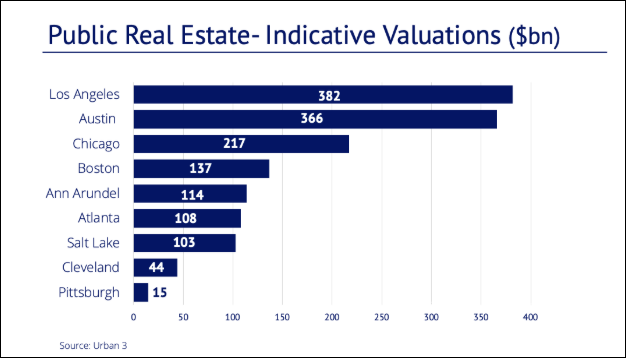
Realistically, municipalities need both land value taxation and land leasing. Land in American cities is a mix of private and public holdings. Whatever the specific combination of leasing and taxation, though, shifting to a land-centric revenue model will set cities up for the next era in American urbanism — and for more than one reason.
This model affords city administrators a better form of epistemics. Investments in public infrastructure can be more directly tied to ROI on the basis of increasing land values. To be sure, public sector planners are in the practice of evaluating the tax implications of public outlays. But projections of sales tax revenue used to justify public subsidies for things like sports stadiums are often specious exercises in the worst kind of multi-step, hand-wavy, McKinsey slide-deck chicanery. Land values are simply easier to evaluate and project, allowing policymakers to make more sober investment decisions when it comes to public infrastructure.
It’s important to call out here that this model doesn’t just help cities know what to do; it also gives them a reason to actually do it.
All organizations, public or private, develop internal logics based on how they make their money. Consider how the business models of dominant web2 social media platforms like Facebook and Instagram — models based on monetizing attention — influenced how they were built. Every part of each of those products is designed to capture user attention and sell it to advertisers. Product design is always downstream of the business model, and in the world of land use policy, urban development works much the same way.
In the municipal context, there’s a robust literature on the “fiscalization of land use.” The literature’s central observation is that whatever makes a city money, the city will tend to allow more of.
In the context of California — where cities have long been constrained in their ability to collect property taxes — municipalities rely heavily on sales and hotel taxes as sources of revenue. California’s constraints on property taxes have also led to the rise of “fee culture,” in which California cities monetize new development through a bevy of “impact fees” and other administrative surcharges related to the inspection and approval of new housing. Despite the fact that taxing new housing development into oblivion is counterproductive for stabilizing the cost of living (who knew), it’s just how local policymakers think about keeping their books in the black.
And herein lies the issue with most American cities’ fiscal regimes (aside from the aforementioned reliance on federal support): they don’t align the city government’s financial interests with the interests of broad-based economic growth. Refocusing revenue generation on land values, however, would do just that and is another important reason that cities need to rethink their current approach to funding.
One easy misreading of this argument is that land-based revenue only works in already-expensive superstar cities. That gets the mechanism backward. In high-productivity places, the case is obvious. Valuable land is valuable, so taxing it or leasing it out for productive use provides a solid fiscal base. But in lower-productivity cities, the alignment effect may matter much more. A city with weak demand, high vacancy, and too much underused land cannot afford a revenue system that rewards keeping land idle or punishes reinvestment. Taxing buildings, new construction, permits, transfers, and local commerce makes redevelopment harder. Taxing land pushes in the opposite direction. It tells the owner of a valuable-but-underused parcel that they have to use it or lose it. And when that owner is the city itself, it gives policymakers a reason to think about putting valuable assets to productive public use.
So, the point is not that Baltimore can tax land like Manhattan and get Manhattan-level revenue. It cannot. Instead, it’s that places like Baltimore need a fiscal model that makes reinvestment easier and land speculation less attractive.
Why now?
Before we close the argument, it’s worth acknowledging the obvious objection: if any of this makes any sense at all, why don’t we already do it?
For starters, I’ll refer you back to our last post. For at least seven decades, the U.S. federal government has spent money into the American economy in ways that allowed our communities to be built and administered the way they are. That arrangement will not persist. We’re looking at an exogenous shock to the status quo that will start making business as usual increasingly difficult to carry on. If the federal government can simply continue spending at the same levels as it has since World War II without having to make any new tradeoffs, perhaps everything can keep on going as it has. If it can’t, then things cannot.
The other issue is that our engine of middle-class ascendancy via land speculation is breaking down. For seventy years, homeownership — buying a piece of land and expecting local economic growth to deliver above-average returns on your property value — was the route into the middle class. That only worked as long as each new cohort of buyers could afford to pay more than the last, and we’ve now reached the point where that’s no longer the case. The breakdown of that system will make possible the things we need to do next.

The fiercest opposition to land-based revenue has always come from a homeowner majority whose net worth depended on the very appreciation an LVT would discourage (see every property tax revolt ever). But a wealth-building strategy younger folks can’t buy into will eventually run out of defenders. As the millennial and Gen-Z dominated YIMBY movement pushes through reforms that legalize small-lot townhomes, duplexes, rowhouses, and apartment buildings — housing that reduces per capita land consumption — the political economy of land use becomes far less hostile to LVT as a policy, and far more supportive of the kind of development that makes public land leasing viable as well.
In sum, at the same moment American cities need a new answer to municipal finance, the structural logic that long made this land-centric answer intractable is weakening. YIMBYism marches on and, to a great extent, is clearing a path for the types of reforms we’ve been discussing here today.
Outro
Even a perfect revenue model leaves one problem unsolved. Revenue falls in recessions — precisely when cities need to spend. For decades, counter-cyclical spending was Washington’s job. If that backstop is fading, cities will need the capacity to spend into a downturn themselves. And however good local fiscal policy becomes, cities aren’t well situated to manage fluctuations in the macroeconomy.
To manage those storms, cities need a way to build up reserves they can aggressively deploy in a downturn. For more on that, make sure to tune into Part III.
A related policy approach is the Depreciation Assisted Land Value Tax or DALT. The basic insight here is that the decision to build (or not) is an investment decision on the part of developers. New construction, understood as a financial asset, is expected to produce returns over the course of 20–30 years, so exempting improvements for that time period (i.e., making property taxes pure land value taxes for the first 20–30 years after construction) should tip the scales on investment decisions and get more housing built more quickly. Caveats apply; see the full post for all the wonky details.
See Civic Mapper from the Center for Land Economics.
LVT in the U.S. sometimes requires changes to state law. Many state constitutions have something called a uniformity clause which, in effect, treats land and buildings as one class of property (real estate) and says that you can’t have different tax rates for what’s effectively the same type of property. For more on the details (and the work being done to update state constitutions), see this write-up from CLE.
One of the go-to examples is Hong Kong. For as much as I love that city, Benedict Springbett has written extensively on how that system creates rigidities that impede housing development.